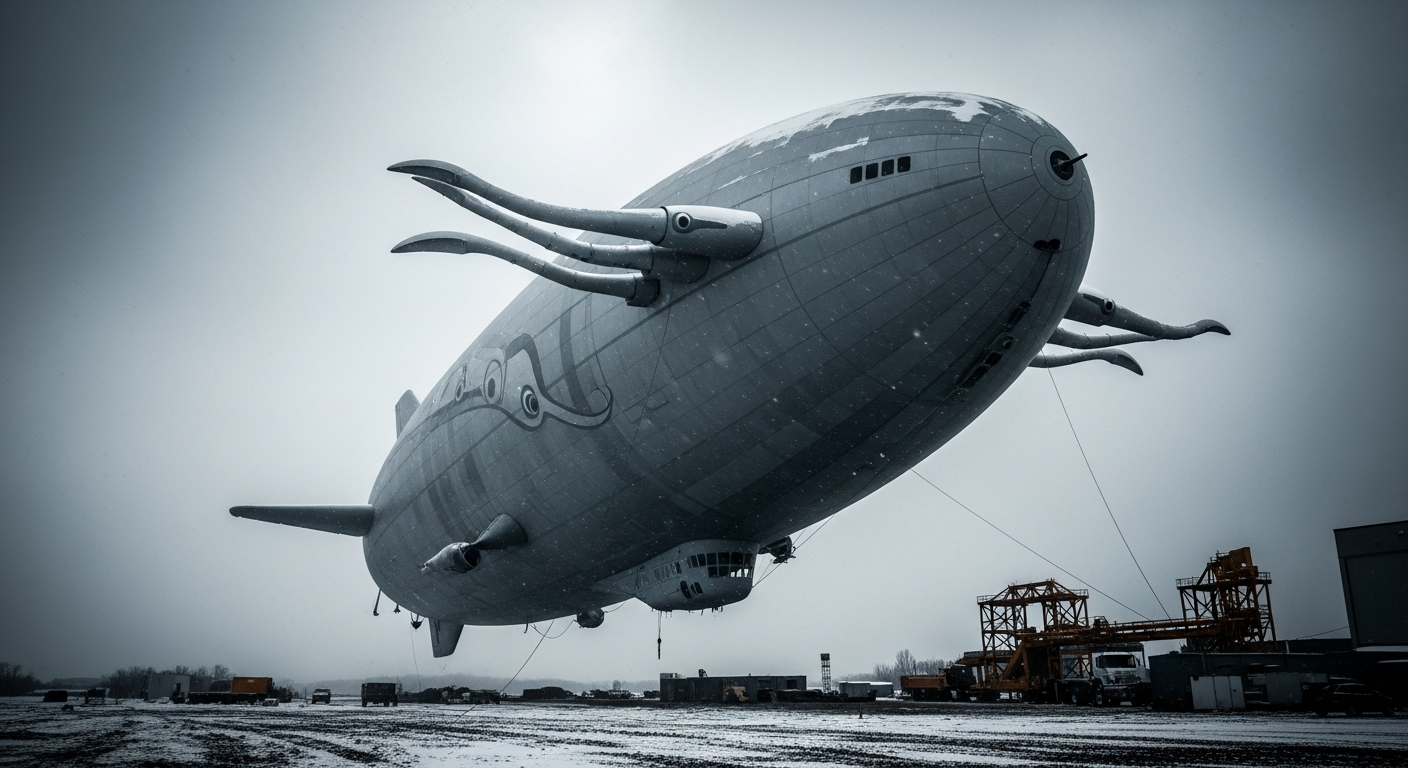
Squid Pro Quo: The Unilateral Lessons for a Bilateral Airship Dream
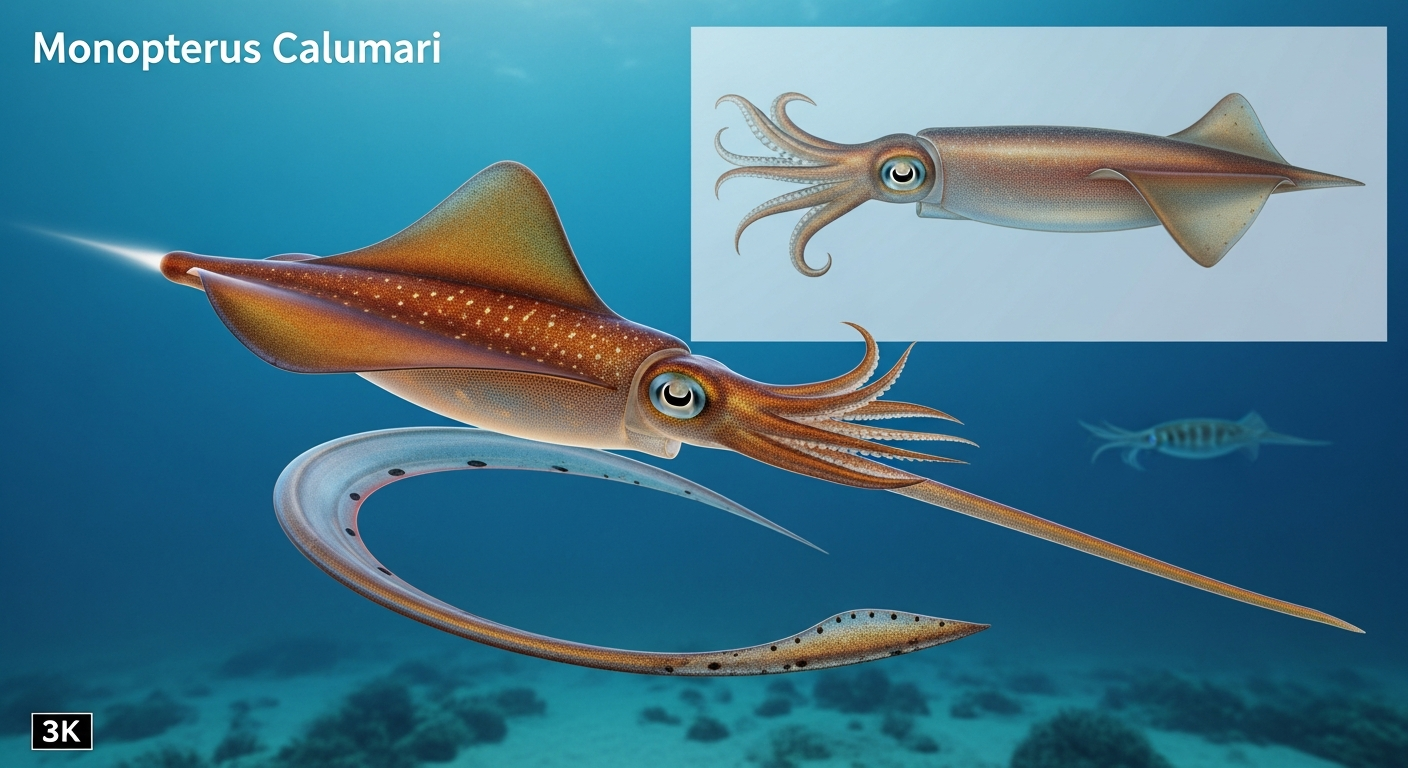
It’s a blustery January day outside Lakehurst, New Jersey. The East Coast of North America is experiencing its worst weather in decades, and all civilian aircraft have been grounded. This, however, is not a tale of a forgotten flight path or a delayed cargo run. This is the story of an epiphany, delivered not by a meteorological anomaly, but by a marine biological one – specifically, the rarely observed, and even less understood, Monopterus Calamari or, as it’s colloquially known in certain academic circles, the one-winged squid. For the beleaguered architects of the 'Airship Renaissance,' this humble cephalopod might just hold the key to navigating the turbulent skies of tomorrow, albeit with a slight list to port.
Key Takeaways:
-
Embrace Asymmetry: Perfection is a theoretical construct. Nature, in its infinite wisdom, often favors 'good enough' over 'ideal.'
-
Compensatory Jet Propulsion: When one system fails, or is entirely absent, the remaining systems must overcompensate with an almost admirable, if inefficient, dedication.
-
The 'Single-Point-of-Failure' Fallacy: Robust design isn't about eliminating failure points, but about continuing function despite them.
-
Prioritizing Momentum Over Direction: Sometimes, forward (or even slightly askew) movement is more critical than precise vectoring. Drifting can be a strategy.
Main Analysis: The Asymmetrical Imperative
The Lakehurst Anomaly and Nature's Imbalance
Lakehurst. The very name evokes grand, if tragic, memories of a previous era's airborne ambitions. Today, as the East Coast grapples with atmospheric conditions that would make even a seasoned barnacle cling tighter, the call for a renewed age of airships resonates with a certain romantic futility. Our modern airship designs, replete with their mirrored gondolas, equidistant engines, and perfectly balanced envelopes, are paragons of symmetrical engineering. They are, in essence, perfectly designed for perfectly calm weather.
Unfortunately, Earth, in its infinite inconsideration, rarely provides such ideal conditions.
This is where the Monopterus Calamari floats into focus. Imagine a squid, a creature renowned for its bilateral symmetry and efficient fin-driven propulsion, yet possessing only one functional fin. How does it move? Not gracefully, certainly. Not in a straight line. But it moves. It compensates. It rotates, it jet-propels with greater force, and it, crucially, survives. It is a masterclass in 'making do.'
Asymmetrical Propulsion: A New Paradigm for the Skies?
Conventional aerospace wisdom dictates that thrust must be balanced. Two engines, three engines, four engines – always in equilibrium. Yet, the one-winged squid challenges this dogma. Its primary mode of locomotion shifts from graceful fin-swaying to a more vigorous, compensatory jet expulsion. While its trajectory might resemble a spiral or an erratic zig-zag, it achieves its goal: getting from point A to point B, even if point B is reached via C, D, and sometimes, F.
For airships, this translates to a radical rethink. What if, instead of striving for perfect balance in the face of inevitable engine failure or structural damage, we designed airships that expect asymmetry? Imagine a multi-chambered envelope where selective deflation on one side, paired with enhanced thrust on the other, allows for controlled, albeit unorthodox, flight after partial failure. The 'squid maneuver' – a deliberate, controlled wobble – could be the emergency protocol of the future, enabling a slow, spiraling descent rather than a catastrophic plunge.
The Cost of 'Optimal': Learning from Lopsided Life
The pursuit of 'optimal' design in engineering often overlooks the robustness inherent in less-than-perfect natural systems. Our airships, meticulously crafted for theoretical peak performance, often become brittle when confronted with real-world variables – a sudden microburst, an unexpected ice accretion, or, God forbid, an actual one-winged squid getting lodged in a propeller. The Monopterus Calamari, by its very existence, teaches us that robust functionality is not about achieving perfection, but about tolerating and adapting to imperfection.

Perhaps the next generation of airship designers should spend less time in wind tunnels simulating ideal airflows and more time observing how a genuinely disadvantaged mollusk navigates its fluid environment. Its survival strategy is not elegant, but it is undeniably effective in its niche. The Airship Renaissance cannot afford to repeat the mistakes of its past by designing magnificent machines that are only magnificent under pristine conditions. The skies are rarely pristine.
Public Sentiment
The public, ever wary of anything that reminds them of the Hindenburg, has reacted to these peculiar biological parallels with a mix of bemusement and cautious optimism. Dr. Alistair Finch, a self-proclaimed 'Cephalopod Aero-Dynamacist' from the University of North Dakota, stated, "Frankly, if a squid can achieve directional movement with a significant biological handicap, then our multi-billion dollar airship projects, despite their minor structural nuances, should certainly be capable of doing the same. It's simply a matter of recalibrating our expectations for 'straight line'."
Meanwhile, Agnes Periwinkle, a resident of Barnegat Bay, NJ, mused, "I just hope they don't start smelling like calamari when they finally float by. And for heaven's sake, give them two wings this time. Or fins. Whatever. Just make sure they can get somewhere in a straight line, eventually."
Conclusion
The Airship Renaissance stands at a crossroads. Will it continue to pursue the elusive phantom of symmetrical perfection, or will it embrace the lopsided lessons offered by the most unlikely of mentors? The one-winged squid, navigating its underwater world with a charming, if inefficient, tenacity, provides a compelling argument for a paradigm shift. In a world where perfection is a statistical anomaly, perhaps the greatest engineering triumph lies in designing for the inevitable imperfection. Let our future skies be filled not with fragile, symmetrical dreams, but with robust, slightly askew realities, inspired by the tenacious, one-winged champions of the deep. The path to industrial flight, it seems, might just be a little wobbly, but it will be a path forward nonetheless.