Laurie Spiegel's Enduring Vision: Deconstructing Algorithmic Music in the Age of AI Hype
[FEATURED]
In the annals of electronic music and digital art, few figures loom as large or offer as prescient a perspective as Laurie Spiegel. From her seminal work at Bell Labs to her groundbreaking software for personal computers, Spiegel has not merely observed the evolution of technology in art—she has actively shaped it. Today, as the industry grapples with the ethical and creative implications of 'AI,' Spiegel's clear-eyed distinction between truly algorithmic music and the current iterations of generative 'AI' provides an indispensable framework for understanding our technological present and future.
Key Takeaways
-
Pioneering Accessibility: Laurie Spiegel made algorithmic music creation accessible to the public with her 1986 software, Music Mouse.
-
Human-Centric Algorithms: Her work emphasizes human-designed rules and intentionality as core to algorithmic composition, empowering users rather than replacing them.
-
The 'AI' Distinction: Spiegel differentiates algorithmic music, built on transparent, human-crafted systems, from contemporary 'AI' music, which often relies on opaque statistical models and pattern recognition.
-
Preserving Agency: Her philosophy champions human understanding and control within the creative process, advocating for tools that augment rather than automate creativity entirely.
-
Enduring Relevance: Spiegel's insights are more critical than ever, offering a vital perspective on creativity, ownership, and the role of technology in artistic expression.
The Genesis of Music Mouse: Algorithmic Art for All
Before the widespread adoption of the internet or even graphical user interfaces, Laurie Spiegel envisioned a future where anyone could engage with sophisticated musical ideas. In 1986, she released Music Mouse, a deceptively simple yet profoundly powerful software for early personal computers like the Macintosh, Atari, and Amiga. The premise was revolutionary: notes were arranged on an XY grid, and by merely moving a computer mouse—a device then still novel to many—users could intuitively generate complex musical patterns.
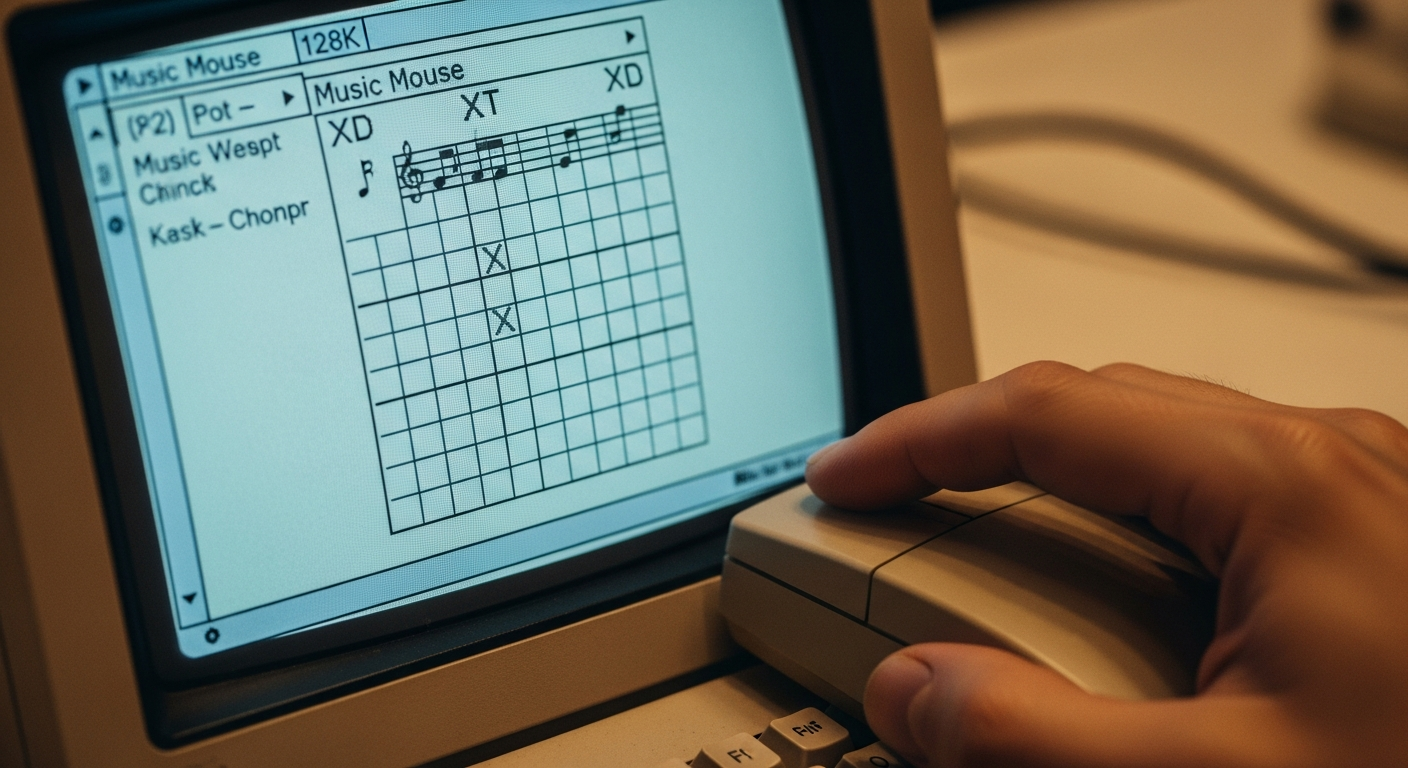
Music Mouse wasn't just a toy; it was an educational tool and a creative gateway. It taught users the principles of algorithmic composition not through arcane programming languages, but through direct, visual interaction. The underlying algorithms, designed by Spiegel, translated mouse movements into musical parameters, creating compositions that were both structured and emergent. This democratic approach to music creation demonstrated Spiegel's belief in technology as an enabler, a means to empower individuals to explore their own musicality without needing extensive formal training or specialized equipment.
A Visionary's Trajectory: Beyond the Mouse
Spiegel's contributions to music technology far predate Music Mouse. Having worked at Bell Labs in the 1970s, a crucible of scientific and artistic innovation, she was at the forefront of computer music experimentation. Her 1980 album, The Expanding Universe, is widely revered as a landmark in ambient music, showcasing her mastery of early digital synthesis and her profound understanding of musical texture and form. She developed early software systems for compositional control, experimented with interactive audio, and continually pushed the boundaries of what electronic instruments could achieve. Her career trajectory underscores a consistent commitment to leveraging technology to explore new sonic landscapes and make advanced compositional techniques accessible.
Algorithmic vs. 'AI': A Crucial Distinction
What makes Spiegel's contemporary commentary particularly incisive is her sharp delineation between what she terms 'algorithmic music' and the current buzz surrounding 'AI' music. For Spiegel, algorithmic music, as exemplified by Music Mouse, involves systems where the rules of composition are explicitly designed by humans. The programmer is akin to a composer of rules, and the output is a direct, albeit complex, consequence of those predefined parameters. The human hand guides the algorithm, even if the resulting music surprises.
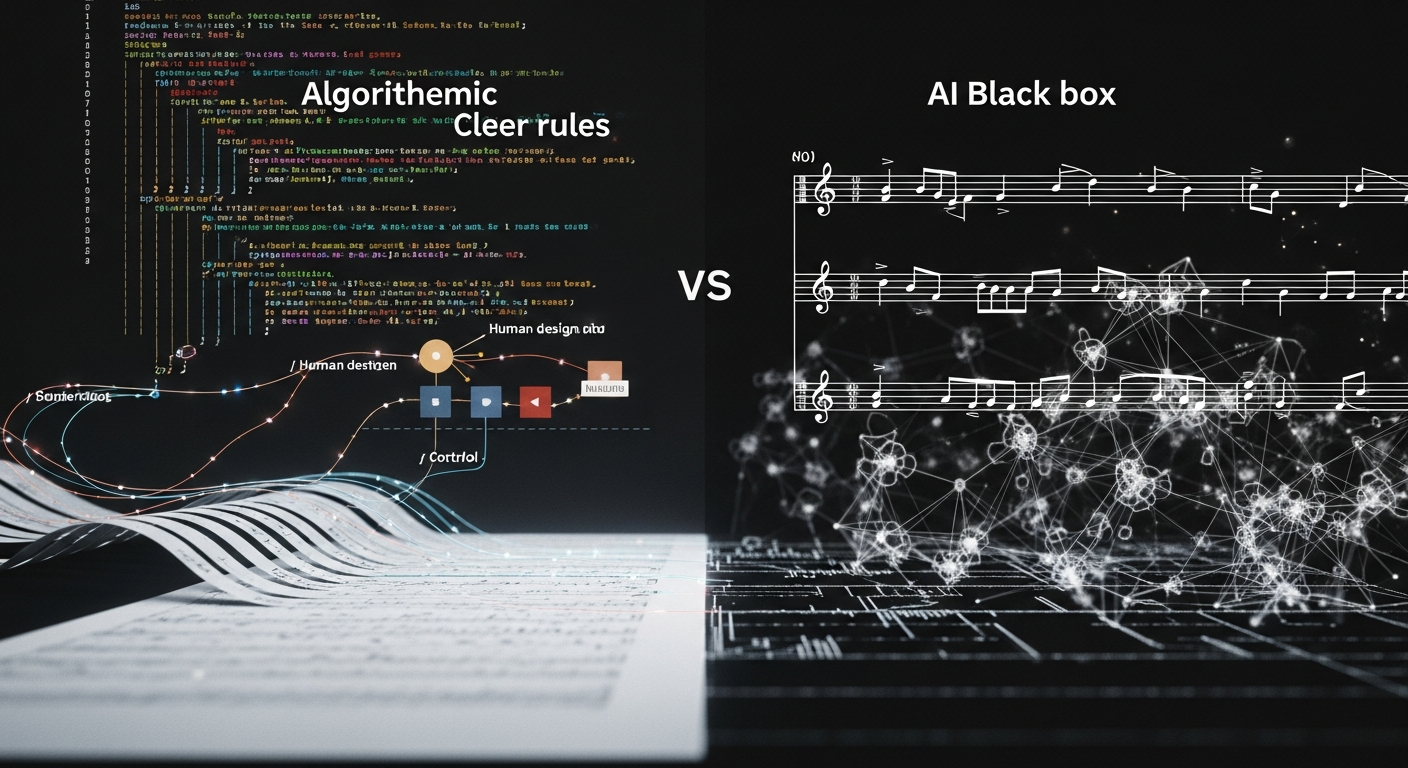
Conversely, much of what is currently branded as 'AI' music, particularly generative AI, operates differently. These systems are often trained on vast datasets of existing music, learning statistical relationships and patterns. When prompted, they generate new content based on these learned probabilities, often without a transparent, human-designed rule set dictating each compositional choice. Spiegel's concern, and one echoed by many purists, is that this process can obscure human agency. The 'AI' acts more as a sophisticated predictor or mimic, and its internal workings are often a 'black box,' making it difficult for a human composer to understand, control, or take credit for the specific creative decisions made by the machine. The intention shifts from augmenting human creativity with explicit tools to potentially replacing it with an autonomous, albeit pattern-matching, entity.
This distinction is not merely semantic; it speaks to fundamental questions of authorship, intentionality, and the very definition of creativity. Algorithmic music, in Spiegel's view, provides a framework within which human creativity operates, offering new palettes and structures. 'AI' music, by often divorcing the artist from the explicit generative rules, raises complex questions about who—or what—is truly 'composing.'
The Enduring Legacy and Call to Agency
Laurie Spiegel's work serves as a powerful reminder that technological advancement in art should ideally empower the human creator, providing new means for expression and exploration. Her early embrace of the computer as a musical partner, rather than a replacement, laid the groundwork for countless artists and developers. Today, her voice cuts through the hype, urging us to consider the underlying principles of the tools we use and the nature of the art they help us create. Her legacy is a testament to thoughtful, human-centric design in technology, a philosophy that remains profoundly relevant in our increasingly automated world.
Public Sentiment
The public and critical appreciation for Laurie Spiegel's foresight and clarity is palpable. Musicians and technologists alike often point to her work as a touchstone in understanding the true potential of digital creativity.
-
"Spiegel's work with Music Mouse wasn't just innovative; it was a masterclass in making complex ideas accessible. It showed us that algorithms could be instruments, not just code." — Digital Composer & Educator
-
"Her distinction between algorithmic music and today's 'AI' is vital. It's about maintaining artistic control and understanding the 'why' behind the creation, not just the 'what'." — Music Technology Critic
-
"You can feel the human intention in Spiegel's algorithmic pieces. It's not about the machine doing the work, but about the artist building an intelligent system to explore new musical terrain." — Independent Musician
Conclusion
Laurie Spiegel stands as a beacon for thoughtful innovation. Her career illustrates a consistent commitment to designing tools that empower artists, expanding their creative universe without diminishing their agency. In a world increasingly eager to hand over creative tasks to 'AI,' Spiegel's insistence on understanding the mechanics—the algorithms—behind the art is a crucial lesson. It reminds us that the most profound technological advancements in creativity are those that illuminate, rather than obscure, the human spark.