
Key Takeaways
-
Finnish Unicorn Goes Public: IQM, a quantum computing leader headquartered in Finland, is set to list on U.S. stock markets.
-
Significant Valuation: The company's public debut is expected to value it at approximately $1.8 billion, reflecting robust investor interest.
-
SPAC as a Vehicle: IQM is utilizing a Special Purpose Acquisition Company (SPAC) for its listing, a popular route for technology firms.
-
Growing Quantum Cohort: This move places IQM among an expanding group of quantum computing companies now accessible to public investors.
-
European Innovation, Global Capital: The listing highlights a growing trend of European deep-tech innovation attracting substantial capital from U.S. markets.
[FEATURED]
Main Analysis
The Quantum Computing Landscape: A New Frontier of Computation
Quantum computing, once confined to theoretical physics labs, is rapidly transitioning into a tangible industry poised to redefine the limits of computation. Unlike classical computers that store information as bits (0s or 1s), quantum computers leverage quantum mechanical phenomena like superposition and entanglement to process information in fundamentally new ways. This unique capability promises to unlock solutions to problems currently intractable for even the most powerful supercomputers, ranging from drug discovery and material science to complex financial modeling and advanced artificial intelligence.
However, the technology remains in its early stages of development. Building and maintaining quantum computers presents immense engineering challenges, requiring ultra-cold cryogenic environments and precise control over delicate quantum bits (qubits). Despite these hurdles, the potential rewards are so vast that governments, large corporations, and venture capitalists are pouring billions into research and development, creating a competitive global race to achieve quantum advantage.
IQM's Strategic Path: The SPAC Advantage
IQM's decision to go public via a SPAC is a strategic maneuver gaining traction among high-growth technology companies, particularly those in capital-intensive sectors like quantum computing. A SPAC, often referred to as a "blank check" company, raises capital through an initial public offering (IPO) with the sole purpose of acquiring an existing private company. For companies like IQM, a SPAC merger offers several advantages over a traditional IPO.
Firstly, it can be a faster and less cumbersome route to public markets, potentially bypassing some of the rigorous regulatory scrutiny and extended roadshow periods associated with conventional IPOs. Secondly, it provides a degree of certainty regarding valuation and capital infusion, as the terms of the merger are often negotiated privately before the public announcement. For IQM, a company requiring substantial ongoing investment for R&D, scaling infrastructure, and attracting top talent, access to significant public capital is paramount for accelerating its ambitious roadmap. The $1.8 billion valuation reflects not just its current technological prowess but also the market's anticipation of its future growth and impact.
A Maturing Market? Investor Confidence and Risk
The entry of IQM onto public markets signifies a deepening confidence among investors in the long-term potential of quantum computing. Over the past few years, several other quantum firms, such as IonQ, Rigetti Computing, and D-Wave Systems, have also gone public, predominantly through SPACs. This growing cohort suggests a shift from pure speculative venture capital funding to a broader public market appetite for quantum assets.
However, it is crucial to acknowledge the inherent risks. Quantum computing is still largely a pre-revenue or early-revenue industry. Commercial applications are emerging but are not yet widespread, and profitability remains a distant goal for many players. Investors in these companies are betting on future technological breakthroughs and market adoption, making these investments inherently volatile and suited for those with a high tolerance for risk and a long-term perspective. The market is distinguishing between companies with viable roadmaps and strong intellectual property versus those merely riding the hype cycle. IQM, with its focus on superconducting quantum processors and full-stack quantum computers, aims to position itself in the former category.
Finland's Deep Tech Contribution
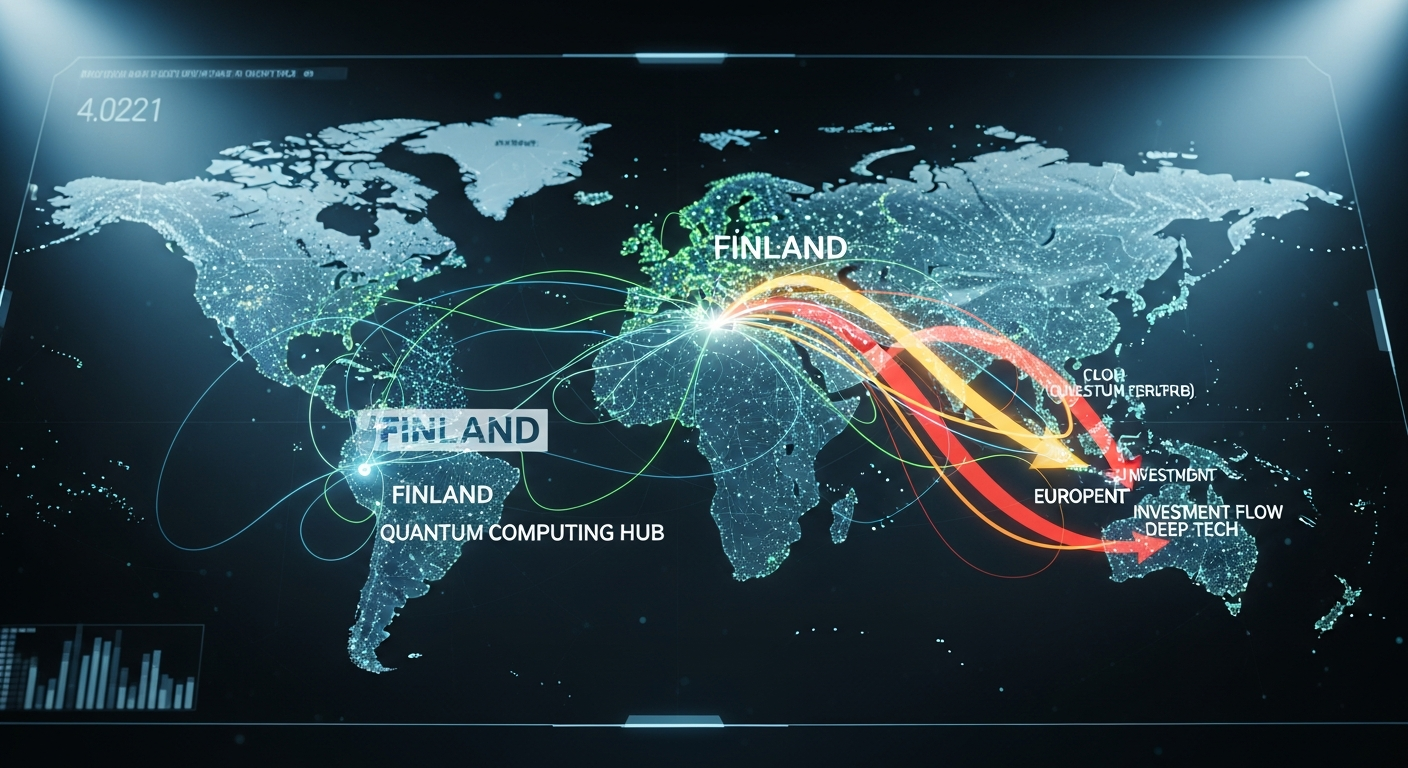
IQM's origin in Finland highlights the Nordic nation's growing prominence as a hub for deep technology innovation. Finland has consistently invested in research and development, fostering a strong ecosystem of highly skilled engineers, physicists, and entrepreneurs. The country's commitment to cutting-edge science, often supported by public-private partnerships, has allowed companies like IQM to develop highly sophisticated technologies that require significant intellectual capital and long development cycles.
This trend of European deep-tech companies seeking U.S. public markets is not new but is accelerating. European startups, particularly in specialized fields like quantum, often find more substantial pools of capital and greater liquidity in the larger U.S. stock exchanges, enabling them to compete on a global scale. This cross-border capital flow is vital for scaling technologies that have the potential for global impact.
Public Sentiment
Public sentiment surrounding quantum computing IPOs is a mix of excitement and measured caution. Enthusiasts point to the transformative potential across industries, viewing these listings as early opportunities to invest in the next computing revolution. "IQM going public is a strong signal that quantum is no longer just a research curiosity; it's a rapidly commercializing industry," commented one industry analyst on a tech forum. "Early investors are clearly seeing the long-term value."
Conversely, skeptics highlight the significant technological hurdles and the extended timeline for widespread commercial viability. "We've seen tech hypes before," warned a financial blogger. "While quantum is undeniably powerful, investors need to understand the fundamental risks and the long road to profitability. Valuations like $1.8 billion are based heavily on future potential, not current earnings." Yet, even cautious observers acknowledge the strategic importance, with one venture capitalist stating, "These public listings, especially from robust European players like IQM, are essential for driving innovation and bringing much-needed capital to a critical sector."
Conclusion
IQM's planned public listing via SPAC is more than just a financial event; it is a significant milestone for the global quantum computing industry. It reflects growing investor confidence, signals the maturation of the sector, and underscores the critical role of accessible capital markets in fostering deep-tech innovation. While the path to pervasive quantum computing is undoubtedly complex and fraught with challenges, the influx of public funding for companies like IQM will accelerate research, development, and ultimately, the realization of quantum technology's transformative promise. As the "Rusty Tablet" has consistently observed, the convergence of pioneering technology and strategic capital is the bedrock of future industrial revolutions, and quantum computing is now firmly positioned at the vanguard of this dynamic evolution.