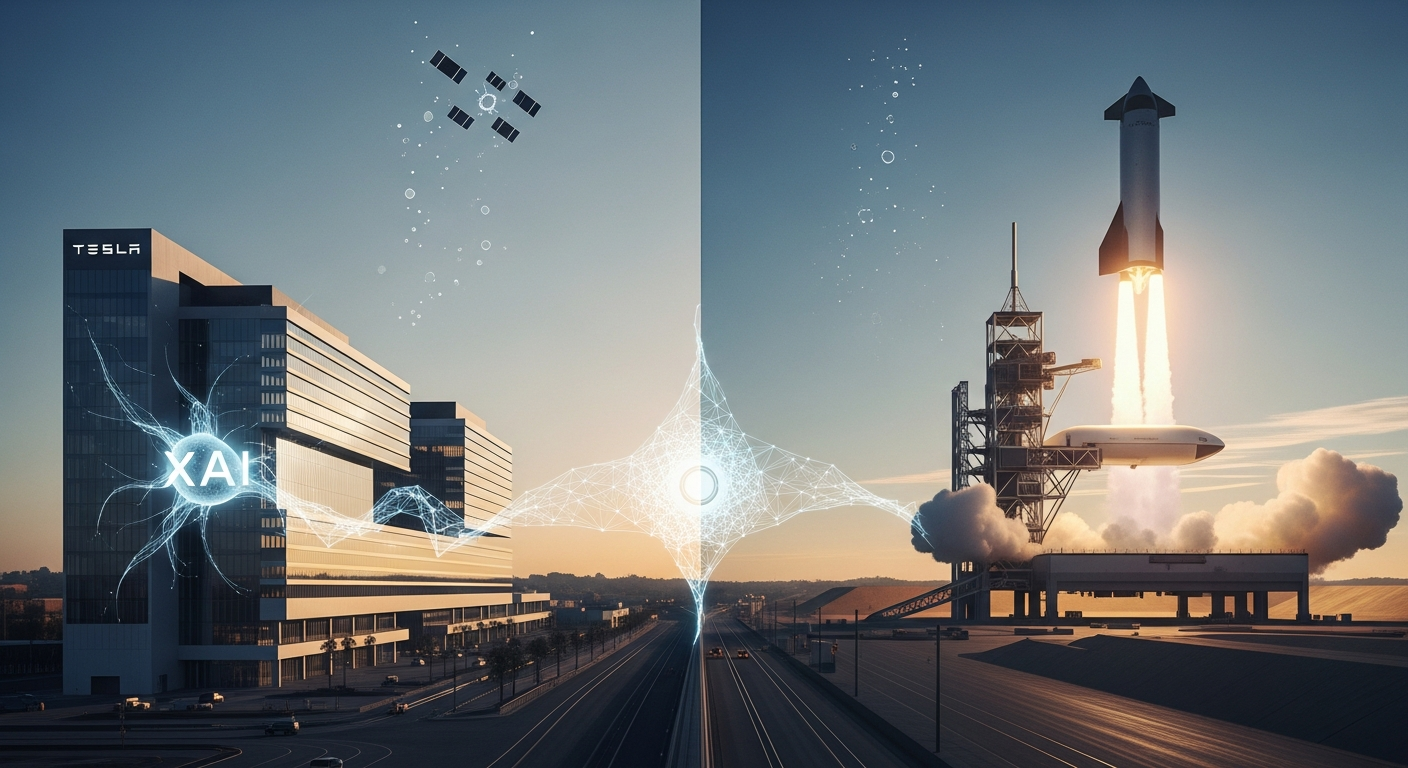
The technological landscape is abuzz with reports of a potential corporate titan in the making: a merger between Elon Musk’s SpaceX, Tesla, and his nascent artificial intelligence firm, xAI. This audacious move, if realized, would coalesce three of the most ambitious and transformative companies of our era under a single, unified banner, promising an unprecedented level of integration across space exploration, terrestrial technology, and advanced artificial intelligence.
Key Takeaways
-
Unprecedented Integration: A proposed merger would unite AI (Grok), global space internet (Starlink), and terrestrial tech (Tesla EVs, robotics) under a single, colossal entity.
-
Strategic Vision Realized: This move aligns with Musk's long-term vision of accelerating human consciousness and creating a self-sustaining, multi-planetary species, leveraging AI, connectivity, and advanced hardware.
-
Market Disruption: The combined entity could reshape competition in automotive, aerospace, telecommunications, and AI sectors, presenting a formidable challenge to existing tech giants.
-
Regulatory Scrutiny Ahead: A deal of this magnitude is highly likely to face intense antitrust review across multiple international jurisdictions due to its potential for market dominance.
-
Operational Complexities: Integrating three distinct corporate cultures and highly specialized operational frameworks presents significant management and logistical hurdles.
Main Analysis
The Strategic Imperative: Why Merge Now?
Elon Musk's ventures have always been characterized by audacious goals and a long-term vision. The reported merger talks for SpaceX, Tesla, and xAI appear to be a direct manifestation of this strategic foresight, aiming to create a vertically integrated technology ecosystem unmatched in scope. At its core, the motivation likely stems from an imperative to accelerate the development and deployment of advanced artificial intelligence, a field Musk has repeatedly emphasized as critical, yet fraught with peril if not guided responsibly.
By bringing xAI's Grok chatbot and its underlying AI research directly into the fold of Tesla's vast real-world data generation and SpaceX's immense computational and networking capabilities, the pathway to achieving Artificial General Intelligence (AGI) or at least highly advanced specialized AI could be significantly shortened. The combined entity would command unparalleled resources—from the data streams of millions of Tesla vehicles to the global reach of Starlink satellites and the supercomputing power required for AI training. This consolidation suggests a drive for efficiency, resource optimization, and a unified strategic direction to achieve Musk's stated ambitions more rapidly.
Synergies Unlocked: Grok, Starlink, and Tesla
The potential synergies between these three entities are profound and multi-faceted. Imagine a future where:
-
AI for Everything: xAI's Grok, designed to understand the universe, could become the intelligence layer for Tesla’s autonomous driving systems, robotics (like Optimus), and even the complex operations of SpaceX's Starship. This integrated AI could process vast amounts of data from diverse sources, making real-time decisions that enhance safety, efficiency, and capability across all domains.
-
Connectivity Backbone: Starlink, SpaceX's global satellite internet constellation, would provide the low-latency, high-bandwidth communication backbone for this integrated ecosystem. It could enable seamless over-the-air updates for Tesla vehicles globally, facilitate distributed computing for xAI's demanding models, and provide critical communication links for future Martian missions.
-
Hardware and Data Loop: Tesla's fleet of vehicles, with their sophisticated sensor arrays, generate petabytes of real-world data crucial for training advanced AI models. This data, fed directly to xAI, could accelerate the learning process for Grok, while Tesla's manufacturing prowess could be leveraged for future hardware innovations born from xAI's research or SpaceX's needs. SpaceX's engineering might, in turn, could contribute to developing specialized hardware for AI or advanced robotics.
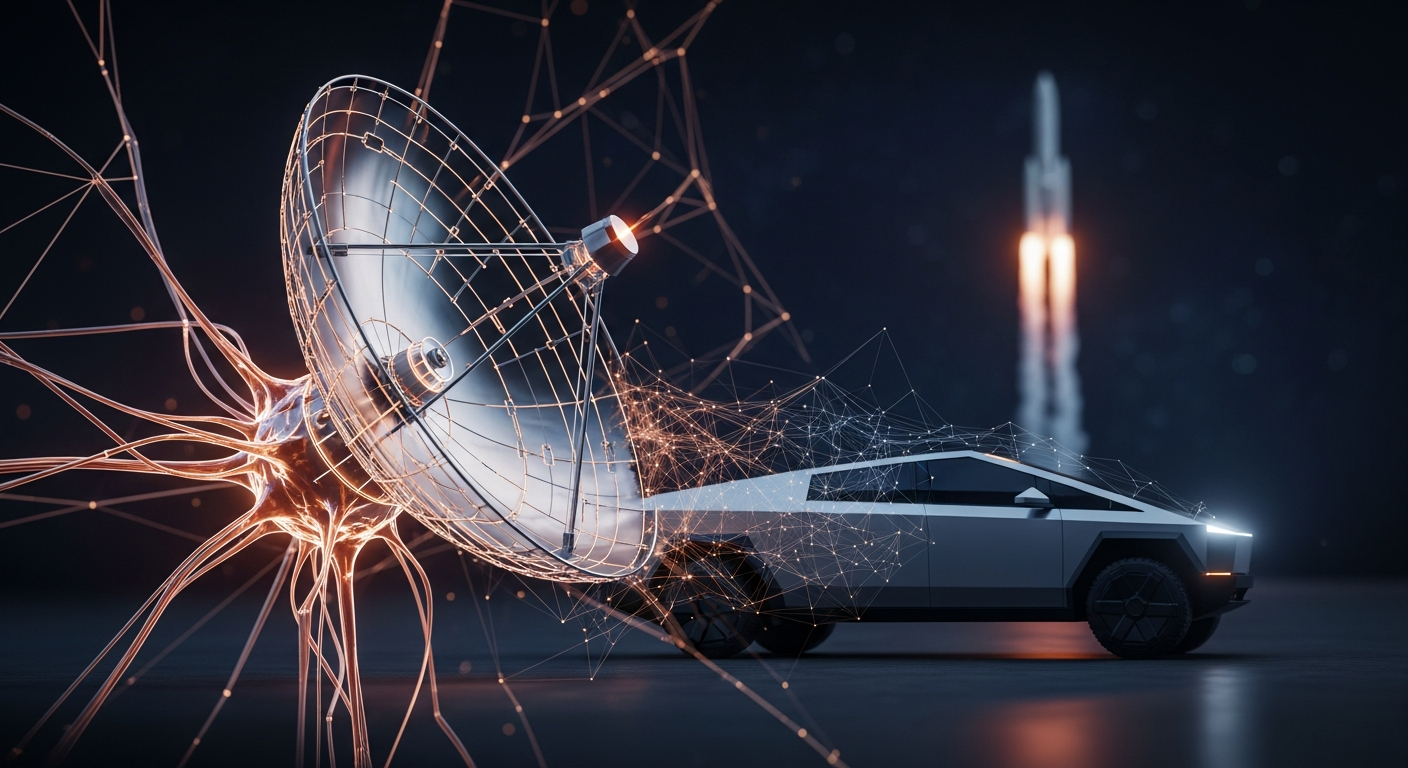
These integrations promise a closed-loop innovation cycle, where advances in one area directly fuel progress in others, creating a powerful network effect that could leave competitors struggling to keep pace.
Market Implications and Regulatory Hurdles
A merger of this scale would undeniably send shockwaves through global markets. The combined entity would command a staggering market capitalization, potentially exceeding a trillion dollars, and would be a direct competitor to established giants across multiple sectors, from automotive and aerospace to telecommunications and big tech. Traditional automakers, rival space companies, and AI developers would suddenly face a competitor with unparalleled vertical integration and a founder known for disrupting entire industries.
However, a deal of this magnitude would also invite intense scrutiny from regulatory bodies worldwide. Antitrust concerns would be paramount, as governments in the US, Europe, and elsewhere would analyze the potential for monopolistic practices across critical technological sectors. Questions would arise regarding fair competition, data privacy, and the control of essential infrastructure like global internet connectivity and advanced AI. Navigating these regulatory hurdles would be a monumental task, potentially leading to lengthy approval processes or even demands for concessions.
Operational Complexities and Cultural Alignment
Beyond the strategic and market implications, the operational challenges of merging SpaceX, Tesla, and xAI are immense. Each company possesses a distinct corporate culture: SpaceX, a fast-paced, engineering-first organization pushing the boundaries of rocketry; Tesla, an innovative, sometimes chaotic, consumer-facing giant focused on electric vehicles, batteries, and AI; and xAI, a lean, research-intensive startup focused on fundamental AI development. Reconciling these diverse cultures, leadership structures, and operational methodologies would require extraordinary management and a clear vision for the unified entity.
Employee retention could also become a significant concern. Highly specialized talent, accustomed to the unique environments of their respective companies, might find integration challenging. Ensuring continuity of innovation while streamlining R&D efforts and supply chains across such disparate fields would test the limits of corporate governance.
Public Sentiment
Public reaction to the merger reports has been largely polarized, reflecting the often-divided opinions surrounding Elon Musk's ventures. Enthusiasts view the potential consolidation as a bold, visionary step forward, believing it will accelerate humanity's progress in space, AI, and sustainable energy. They foresee a future where interconnected technologies create solutions to some of the world's most pressing challenges. Critics, however, voice concerns about the increasing concentration of power in one individual's hands, the potential for monopolistic control over critical technologies, and the sheer complexity of managing such a vast and diverse empire. Investors are watching closely, weighing the immense potential upside against the significant integration risks and regulatory hurdles that lie ahead.
Conclusion
The reported merger talks between SpaceX, Tesla, and xAI represent a pivotal moment in the history of modern technology. If successful, it would create an entity unlike any other, capable of shaping the future of space travel, artificial intelligence, and terrestrial transportation on an unprecedented scale. While the strategic advantages are compelling, the operational complexities, cultural integration challenges, and inevitable regulatory scrutiny will test the limits of even Elon Musk's ambitious leadership. The outcome of these discussions, and any subsequent integration, will undoubtedly be a defining narrative for the next decade, with profound implications not just for the companies involved, but for the entire technological frontier and the global economy.