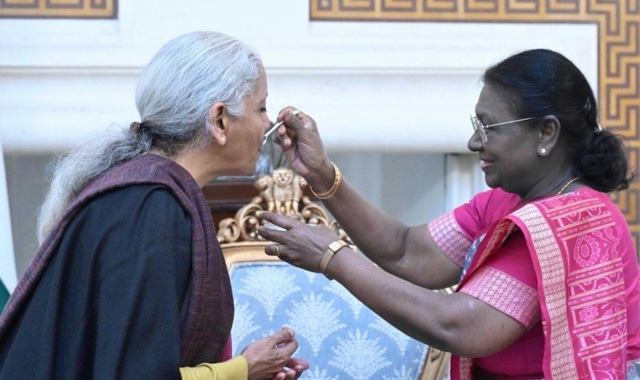
The morning before the Union Budget 2026 presentation, a seemingly intimate yet profoundly public ritual unfolded at Rashtrapati Bhavan. President Droupadi Murmu, in a gesture steeped in tradition, offered 'dahi-cheeni' (curd and sugar) to Finance Minister Nirmala Sitharaman. On the surface, it was a blessing, a wish for good fortune and a smooth task ahead, echoing millions of Indian households. But for a nation poised on the brink of a critical financial roadmap, this act carried a far heavier weight, signaling carefully constructed messages about leadership, legacy, and the very fabric of governance.
[FEATURED]
Key Takeaways
-
Symbolism as Statecraft: The 'dahi-cheeni' ritual, while traditional, is strategically deployed to project an image of stability, divine blessing, and national unity ahead of major economic announcements.
-
Sitharaman's Enduring Stature: Presenting her ninth consecutive budget, Sitharaman not only matches P. Chidambaram's record but solidifies her position as a formidable and enduring figure in Indian economic policy.
-
Continuity Amidst Scrutiny: The collective appearance of the finance team alongside the President's blessing reinforces a narrative of seamless governance and a unified approach to the nation's financial future.
-
Blending Tradition with Modernity: The event highlights the unique Indian political landscape where ancient customs are interwoven with contemporary governmental processes, influencing public perception and trust.
The Ritual: A Blend of Sacred and Strategic
President Murmu's offering was not merely a spontaneous act of cultural warmth; it was a highly visible, meticulously managed media moment designed to resonate across the subcontinent. The dahi-cheeni, a potent symbol of prosperity and success in Indian belief, serves multiple functions in the political arena. It invokes a sense of collective well-wishing, subtly imbuing the impending Budget with a veneer of divine sanction and traditional acceptance. In a country where faith and tradition deeply influence public sentiment, such a gesture can serve to temper anxieties surrounding potentially difficult economic decisions, framing the Budget not just as a policy document but as a collective national endeavor blessed by tradition.
Furthermore, the setting – the stately Rashtrapati Bhavan – and the participants – the Head of State and the Finance Minister – elevate this personal ritual into a significant act of state. It underscores the President's constitutional role as a symbolic guardian of the nation's well-being, bestowing her imprimatur, albeit culturally, on the government's economic agenda. This carefully orchestrated display seeks to instill confidence, suggesting that the Union Budget is not just a technocratic exercise but a journey undertaken with blessings and good intentions.
Sitharaman's Legacy: A Record and a Statement
Finance Minister Nirmala Sitharaman arrived at the presidential residence, clad in a striking magenta silk saree and carrying her tablet in a red pouch emblazoned with the national emblem – an image of poised authority. Her presence, accompanied by her senior team including Union Minister of State for Finance Pankaj Chaudhary, Chief Economic Advisor Dr V Anantha Nageswaran, and CBDT Chairman Ravi Agrawal, projected a united front. More significantly, this budget marks her ninth consecutive presentation, equalling the record of former Finance Minister P. Chidambaram and drawing her closer to Morarji Desai's unparalleled ten budgets in independent India.
This milestone is not merely statistical; it is a profound statement about political stability and the enduring trust placed in her leadership. In the often-turbulent world of Indian politics, a long tenure in a critical portfolio like Finance signals consistency, experience, and a deep understanding of the nation's economic脉搏. It suggests that despite myriad challenges, the government is committed to a steady hand at the financial helm. However, it also raises questions: does such longevity foster innovative thinking, or does it risk entrenching particular approaches? The 'Rusty Tablet' perspective would urge scrutiny into whether this continuity translates into dynamic adaptation or merely steadfast adherence to established paths.
Beyond the Optics: Governance, Public Perception, and the Road Ahead
While the 'dahi-cheeni' ritual and the photographic opportunities it provides are potent symbolic acts, their ultimate impact lies in how they shape public perception. In an era saturated with information and skepticism, these gestures aim to bridge the gap between abstract policy and tangible reassurance. They humanize the often-impersonal process of national finance, connecting it to deeply ingrained cultural values of hope and optimism.
However, an investigative approach mandates asking if such symbolic displays effectively address the underlying economic realities. Does the blessing translate into better economic outcomes for the common citizen? Does the perceived continuity truly offer solutions to inflation, unemployment, or growth deceleration? The public, while appreciative of tradition, ultimately judges budgets on their tangible impact on livelihoods and opportunities. The challenge for the government, post-ritual, is to ensure that the positivity projected through cultural symbols is matched by robust, inclusive, and forward-looking economic policies that justify the nation's faith.
Public Sentiment
Conversations around the country reflect a varied public response to such events:
-
"It's good to see our leaders upholding traditions. It brings a sense of calm before something as big as the Budget." – Sunita Sharma, Homemaker, Lucknow
-
"While traditions are important, I hope the Budget focuses on real solutions, not just good wishes. My grocery bill isn't going down with dahi-cheeni." – Rajesh Singh, Small Business Owner, Delhi
-
"Sitharaman ji's longevity as FM is remarkable. It shows stability. We need that now more than ever, but also bold moves for the economy." – Priya Venkatesh, Software Engineer, Bengaluru
-
"These ceremonies are part of our culture, but they're also excellent photo opportunities. What truly matters is the content of the red pouch." – Arjun Mehta, Retired Banker, Mumbai
Conclusion
The pre-Budget 'dahi-cheeni' offering to Finance Minister Sitharaman is a complex tableau where tradition, politics, and public messaging converge. It is a powerful symbol, carefully deployed to project stability, secure cultural endorsement, and underscore the enduring leadership of the Finance Minister. For 'Rusty Tablet', it serves as a crucial reminder that in India, governance is rarely a purely technocratic exercise; it is deeply interwoven with cultural narratives and public sentiment. As the nation now turns its attention from the symbolic blessing to the detailed numbers, the true test of this Budget, and indeed this government, will be its capacity to transform auspicious beginnings into tangible prosperity for all.