Key Takeaways
-
Emergent Gameplay Core: Big Hops intentionally designs systems that allow and encourage players to manipulate or 'break' the intended flow, fostering creative problem-solving.
-
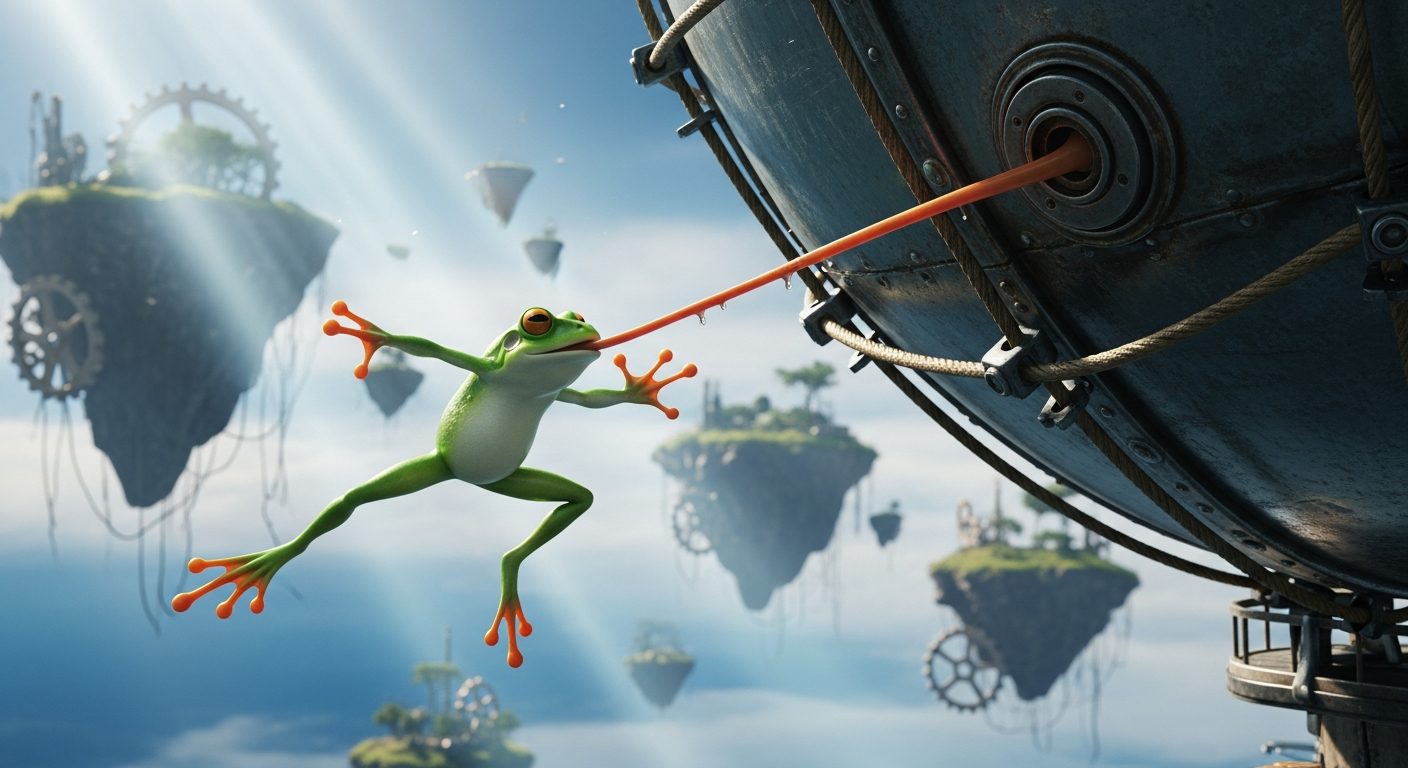
Tongue as a Universal Tool: The protagonist's tongue serves as a versatile multi-tool for combat, traversal, and environmental interaction, centralizing game mechanics around a single, flexible ability.
-
Inspired Remix: The game draws clear inspiration from classic Nintendo 3D platformers and the systemic depth of titles like The Legend of Zelda: Tears of the Kingdom, reinterpreting these elements within an indie framework.
-
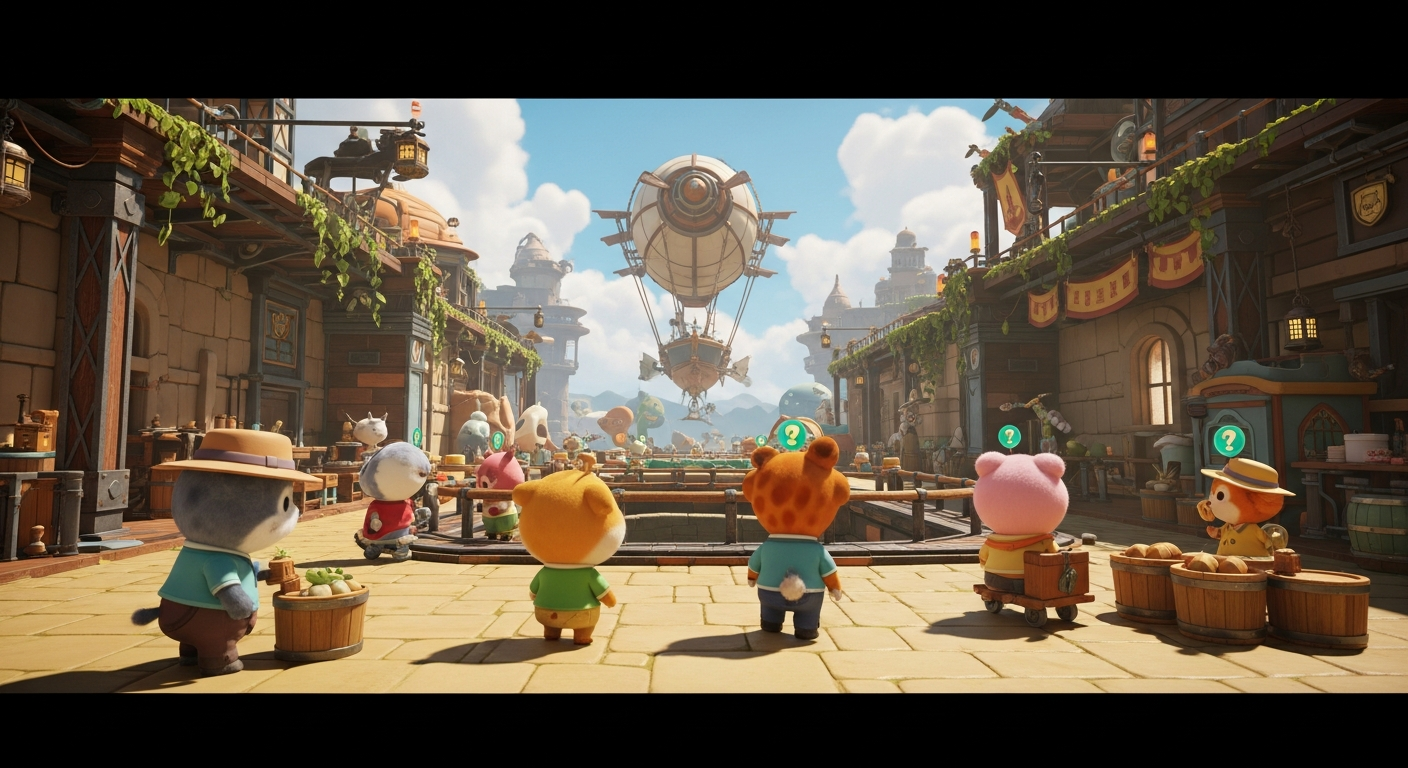
Charming Aesthetic: Despite its complex mechanics, the game maintains an inviting 'cute animal' aesthetic, balancing accessibility with depth.
Main Analysis: The Art of Systemic Manipulation
Introducing Hop and the Multifaceted Tongue Mechanic
Big Hops, a new 3D platformer, introduces players to Hop, an endearing amphibian protagonist embarking on a journey home after being displaced. His quest to collect airship parts spans diverse environments, each populated with unique animal characters and unfolding narratives. At the core of Big Hops' innovative design is Hop's primary interaction method: his tongue. Far from a simple attack, the tongue serves as a remarkably versatile tool, blurring the lines between combat, traversal, and puzzle-solving.
Players can use Hop's tongue to grab and toss pots for coins, grapple across chasms to access new areas, and snag foodstuffs with strategic precision. This singular mechanic provides a robust toolkit, promoting ingenuity and adaptability. The flexibility of the tongue system means that seemingly disparate challenges can often be approached with the same fundamental action, leading to a rich tapestry of player-driven solutions rather than prescriptive pathways.
The 'Breaking the Game' Philosophy: A Parallel to AAA Innovation
Perhaps the most compelling aspect of Big Hops, as highlighted by early impressions, is its deliberate encouragement of systemic exploitation. The feeling of 'breaking the game' is not a bug but a feature, echoing the design philosophy found in critically acclaimed titles like The Legend of Zelda: Tears of the Kingdom. In Tears of the Kingdom, players are given an expansive suite of abilities—Ultrahand, Fuse, Ascend, Recall—that can be combined in myriad ways to bypass traditional obstacles or construct outlandish contraptions. The game thrives on players finding solutions the developers may not have explicitly envisioned, fostering a profound sense of player agency and emergent gameplay.
Big Hops appears to apply a similar principle, albeit on a smaller, more focused scale. By providing a highly flexible core mechanic, it empowers players to experiment, push boundaries, and discover unconventional methods to progress. This approach transforms obstacles into opportunities for creative problem-solving, rewarding curiosity and out-of-the-box thinking. It's a testament to how indie developers can distill complex design philosophies from AAA titles and adapt them into compelling, unique experiences.

Remixing Nintendo's Legacy for a New Era
The comparison to Nintendo's best is not merely about emergent gameplay; Big Hops also appears to be a stylistic and mechanical 'remix' of classic 3D platforming tenets. The collection of airship parts, the progression through distinct themed areas, and the interaction with charming animal characters all evoke the golden age of 3D platformers, particularly titles like Super Mario 64 or Banjo-Kazooie. However, Big Hops transcends mere homage by integrating its unique tongue mechanic and 'game-breaking' philosophy.
This blend of nostalgic familiarity with innovative mechanics positions Big Hops as a modern evolution rather than a simple throwback. It recognizes the foundational appeal of exploration, discovery, and precise movement inherent in Nintendo's design while injecting a fresh layer of systemic depth that appeals to contemporary players who appreciate physics-based interactions and creative freedom. The game effectively leverages a comforting aesthetic to introduce players to its more experimental mechanical core, making complex interactions approachable.
Implications for the Indie Gaming Landscape
Big Hops serves as an important case study for the independent gaming sector. It demonstrates that innovation doesn't always require massive budgets or groundbreaking graphical fidelity but can stem from a clever reinterpretation of established genres and a bold commitment to player freedom. By encouraging players to find their own solutions and even 'break' the game's expected flow, Big Hops challenges traditional linear game design and showcases the potential for emergent narratives born purely from player interaction.
This approach resonates with a growing segment of players who seek deeper engagement and creative outlets within their gaming experiences. For other indie developers, Big Hops offers a blueprint for how to stand out: identify core gameplay loops, imbue them with systemic flexibility, and trust players to derive unique enjoyment from their ability to manipulate those systems.
Public Sentiment
Initial discussions surrounding Big Hops suggest a palpable excitement among players for its unique blend of charm and mechanical depth. Many express enthusiasm for a game that actively encourages creative problem-solving and systemic manipulation, with some directly referencing their positive experiences with similar emergent gameplay in larger titles. The 'cute frog' aesthetic is frequently cited as an attractive entry point, promising a lighthearted yet mechanically engaging experience. There is a general sentiment of anticipation for how extensively players will be able to push the game's systems, with a shared eagerness to discover its hidden possibilities and 'break' it in the most imaginative ways.
Conclusion
Big Hops is poised to be more than just another 3D platformer; it represents a thoughtful evolution of the genre. By centering its design around a versatile core mechanic and boldly embracing the concept of player-driven systemic manipulation, it delivers an experience that is both familiar in its charm and revolutionary in its execution. Its ability to draw parallels with AAA innovation while maintaining a distinct indie identity highlights a promising future for game design where creativity and player agency take precedence over rigid pathways. Big Hops invites players not just to play, but to experiment, discover, and ultimately, to make the game their own.