Key Takeaways
-
The Supreme Authority of 'Respect': President Trump asserts that 'disrespect' towards law enforcement, regardless of context, can have the gravest consequences.
-
Radicalisation by Definition: The deceased, Renee Nicole Good, was posthumously labelled 'radical and violent' by the President, seemingly to justify the actions taken against her.
-
Conflicting Visual Narratives: While administration figures cite video footage to claim self-defence, local leaders and external reports contradict this, highlighting a significant disconnect in perceived reality.
-
The 'Crunch' as Evidence: Trump repeatedly references a 'crunch' sound from the footage, elevating an auditory detail to a critical piece of evidence for the official narrative.
-
Law Enforcement Above All: The incident underscores a broader administration theme: unwavering support for law enforcement and a swift dismissal of any perceived challenges to their authority.
The Unassailable Logic of Presidential Truth
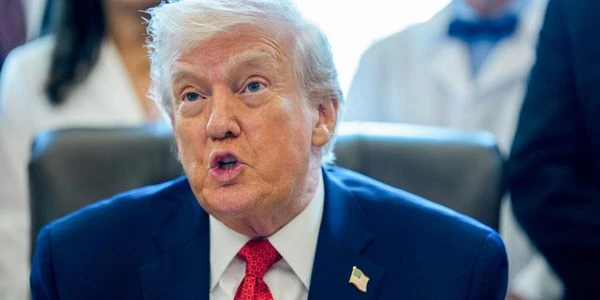
Aboard Air Force One, President Donald Trump delivered his definitive verdict on the Minneapolis ICE shooting: Renee Nicole Good, the 37-year-old mother of three killed by an agent, was 'very disrespectful,' 'very violent,' and 'very radical.' Trump, citing video footage, dismissed concerns about legal intricacies or conflicting reports, stating simply that Ms. Good exhibited a fatal lack of respect. "We have to respect our law enforcement," Trump asserted. "At a very minimum, that woman was very, very disrespectful... You can't do that with law enforcement, whether it's police, or ICE, or Border Patrol or anybody else." For the President, disrespect isn't just a social misstep; it's a dangerous provocation, a pre-crime that justifies extreme action, cementing a new standard for citizen-state interaction.
The 'Crunch' and the 'Weaponized Vehicle': A Narrative of Imminent Danger
To solidify his stance, Trump repeatedly cited the video footage and, critically, a mysterious 'crunch.' "You heard the same noises, you saw the same crunch that I saw," he insisted, elevating an auditory detail to pivotal evidence. Federal officials, including Homeland Security Secretary Kristi Noem, echoed this, alleging Ms. Good attempted to "weaponize her vehicle" against officers. This narrative, swiftly adopted by the administration, paints a picture of extreme peril, where a turning vehicle becomes a deadly projectile and a 'crunch' signifies aggressive intent, redefining reality through a convenient interpretative lens.
The Inconvenience of Alternative Perspectives
Not everyone, however, shares this singular perspective. State and local leaders, including Minneapolis Mayor Jacob Frey and Governor Tim Walz, contend that available video 'does not support claims that Good posed a lethal danger,' noting her vehicle was 'turning away' from officers. Critics suggest this 'turning away' is an inconvenient detail for the official narrative. Meanwhile, Good's family and friends recall a 'compassionate and devoted parent,' a portrayal starkly at odds with the presidential 'radical and violent' label. Even the US Vice President weighed in, sharing video footage and asserting the officer's life 'was endangered and he fired in self defense,' further solidifying the administration's version of events.
Public Sentiment: A Cacophony of Conviction
Amidst conflicting realities, public sentiment remains fractured. Supporters readily embrace the 'disrespect equals consequence' doctrine, with one 'TruthSeeker45' posting, "You disrespect them, you pay the price! Glad to see a President who backs our brave officers!" Others, like 'MinneapolisMom,' voiced bewilderment: "So, turning your car away is now 'weaponizing'? And 'disrespect' gets you a death sentence?" This chasm reveals the ongoing struggle for a shared understanding of justice in a polarized society.
Conclusion: The New Parameters of Engagement
The Renee Nicole Good case, much like the infamous 'crunch,' has become a flashpoint, transcending mere debate over force. President Trump's pronouncements establish a clear hierarchy: law enforcement's authority is paramount, and any perceived lack of 'respect' carries extreme risks. In the Air Force One paradigm, the line between 'disrespectful' and 'lethally dangerous' is remarkably thin. We are left to ponder: Is 'respect' now our most vital self-preservation? And what happens when a 'crunch' alone dictates a narrative shift from tragedy to justified action? The Rusty Tablet will continue to crunch the numbers (and the narratives) for you.