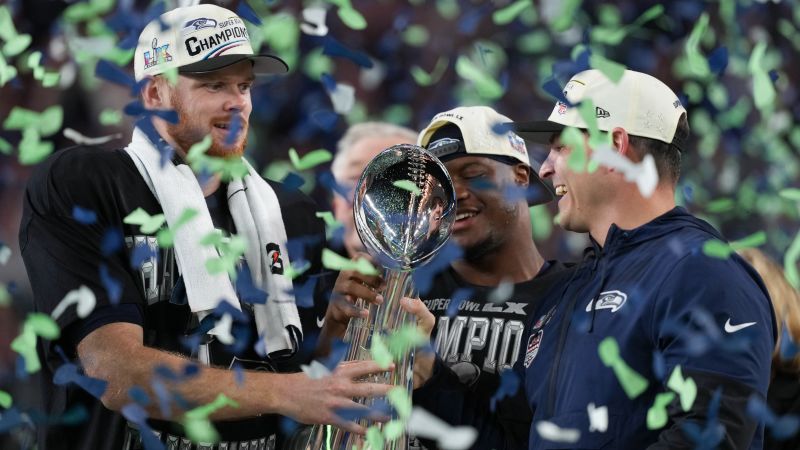
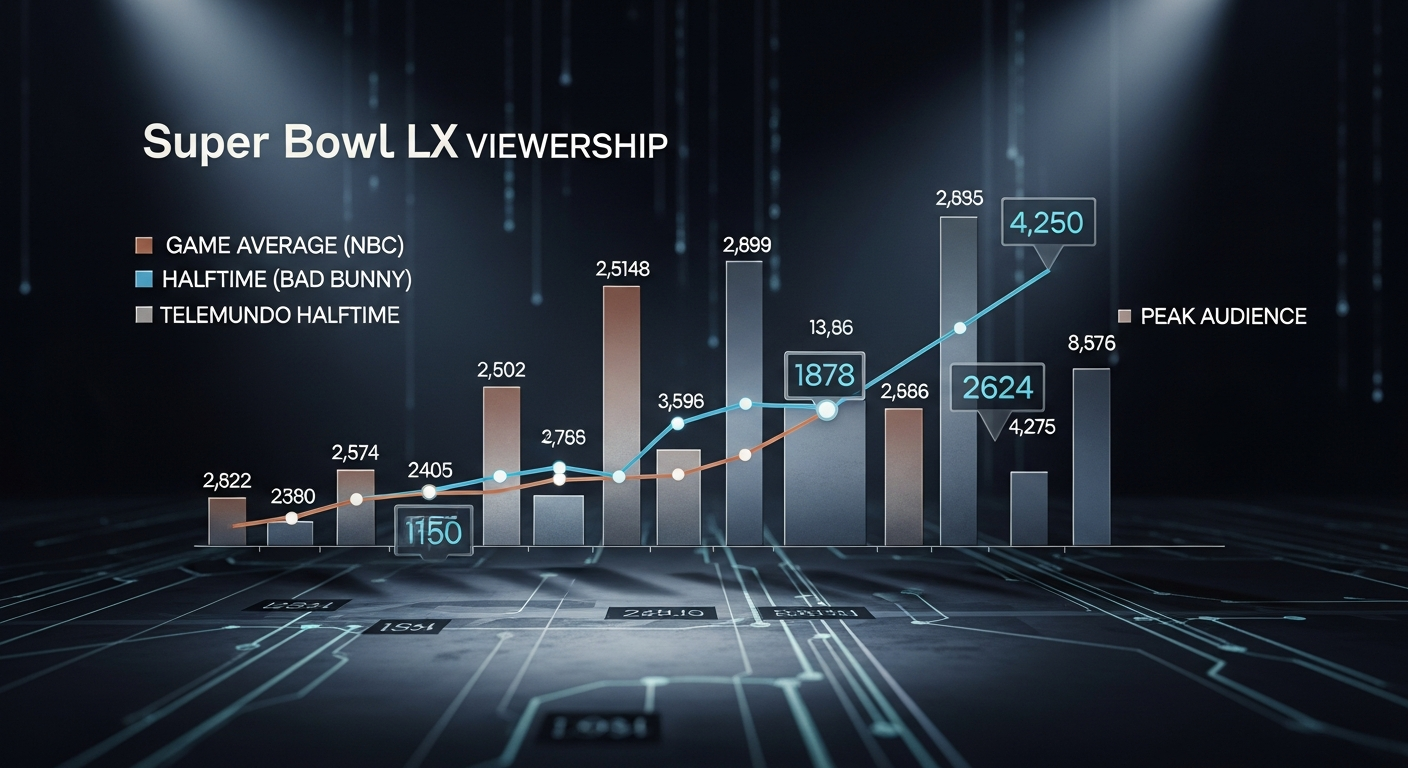
The broadcast of Super Bowl LX on Sunday night drew approximately 125 million viewers in the United States, cementing its place as the most-watched program in NBC's century-long history. Citing Nielsen ratings data, the network announced Tuesday that the game ranked as the second-most watched show in US history, trailing only the previous year's Super Bowl, televised by Fox, which garnered nearly 128 million viewers.
This year's official average per-minute audience across all four quarters stood at 124.9 million. While a slight dip from the previous year, industry analysts attribute this marginal difference in part to a relatively lopsided contest between the Seattle Seahawks and the New England Patriots, which may have led some viewers to disengage earlier than during the tighter 2025 Eagles-Chiefs matchup.
The Halftime Phenomenon: Bad Bunny's Unprecedented Draw
Perhaps the most compelling story from Super Bowl LX viewership data is the extraordinary performance of the halftime show. The heavily scrutinized performance by Bad Bunny registered an even larger audience than the game itself, drawing an astounding 128.2 million viewers. This figure not only surpassed the game's average viewership but also positioned the halftime show as a standalone cultural event capable of attracting and retaining a massive national audience.
The audience for the game itself peaked during the second quarter, reaching 137.8 million concurrent viewers in the US, according to Nielsen. This peak underscores moments of intense engagement during the competitive portions of the game, though it was ultimately overshadowed by the sustained interest in the musical interlude.
Multilingual and Multiplatform Reach
NBC's comprehensive strategy for Super Bowl LX involved a multiplatform and multilingual distribution approach, which proved highly successful. The viewership totals announced included audiences from the NBC and Telemundo broadcast networks, Peacock, NBC Sports Digital, and NFL+.
The Spanish-language Telemundo network averaged a robust 3.3 million viewers for the game. This interest surged dramatically during Bad Bunny's halftime performance, delivered almost entirely in Spanish. During this segment, Telemundo averaged 4.8 million viewers, setting a new record for the most-watched Super Bowl halftime in Spanish-language history. This highlights the growing importance of catering to diverse linguistic demographics and the significant market opportunity present within the US Hispanic community.
Beyond traditional linear television, the halftime performance demonstrated immense digital resonance. NBC, referencing a third-party measurement firm, reported that Bad Bunny's halftime show generated an estimated four billion views across various online and TV platforms within a 24-hour window. Additionally, Apple Music, the halftime show's sponsor, observed a sevenfold increase in streams of Bad Bunny's songs immediately following the telecast, underscoring the direct commercial impact of such a high-profile cultural moment.
In contrast to the mainstream success, a YouTube stream promoted by Turning Point USA as a conservative alternative to Bad Bunny's performance peaked at approximately 6 million viewers. While substantial, it indicates a distinct, albeit smaller, segment of the audience seeking alternative content, although YouTube's viewership metrics are calculated differently from traditional broadcast ratings.
Strategic Programming: The Olympics Lead-in
Leveraging the Super Bowl's perennial status as the year's most-watched event, NBC strategically used the telecast to promote its coverage of the Winter Olympics. This tactical pairing proved highly effective, with the immediate post-Super Bowl Olympics coverage netting a significant 42 million viewers. This robust lead-in demonstrates the enduring value of major live sports events as launchpads for other tentpole programming, driving audience acquisition and awareness for subsequent content.
Public Sentiment
While direct qualitative feedback from viewers is not detailed in the ratings data, the observed viewership trends offer insights into audience preferences and reactions. The slight decrease in overall game viewership compared to the previous year, coupled with reports of viewers tuning out early from a lopsided game, suggests a preference for competitive, closely contested matchups. Conversely, the unprecedented surge in viewership for the Bad Bunny halftime show, particularly across Spanish-language platforms, indicates a strong positive reception and high engagement with culturally resonant, high-production musical performances. The existence of a conservative alternative stream, while smaller, reflects a segment of the audience seeking content aligned with specific cultural or political viewpoints, demonstrating the ongoing diversification of media consumption habits.
Conclusion
Super Bowl LX reinforced the event's unparalleled status as a national spectacle, delivering historic viewership for NBC and showcasing the immense cultural and commercial power of its halftime show. The strategic integration of multiplatform and multilingual distribution, coupled with a successful Olympics lead-in, underscores NBC's adept navigation of the modern media landscape. While game outcomes can influence overall engagement, the Super Bowl's capacity to unify vast audiences, drive cultural conversations, and generate significant economic impact remains undiminished, evolving with audience preferences and technological advancements.