The Inevitable Evolution of 'Unmissable'
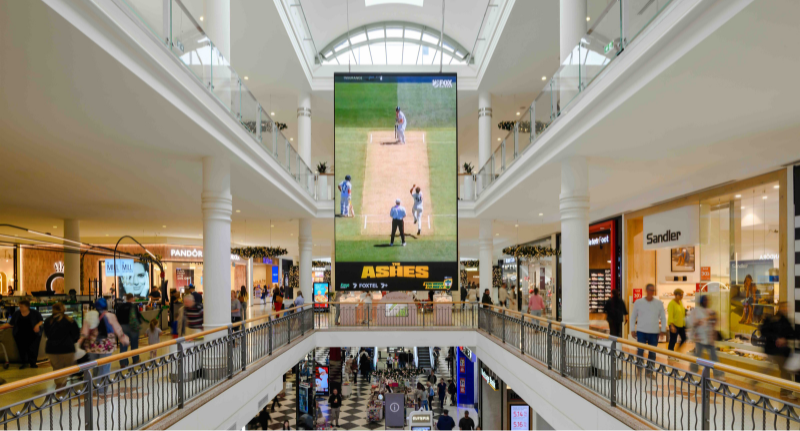
Cricket Australia, in an act of marketing bravado that simultaneously thrilled and mildly terrorised the nation, recently demonstrated how 'unmissable' moments can be manufactured through sheer, overwhelming ubiquity. For the NRMA Insurance Ashes Series, the collective genius of Cricket Australia, Special, Initiative, and oOh!media executed a campaign that didn't just promote the sport; it practically force-fed it to the public via thousands of digital billboards nationwide. This wasn't passive advertising; it was an active occupation of the public gaze, redefining what it means for a moment to be truly 'unmissable' – primarily by making it unavoidable.
Across five Tests, a staggering 4,557 digital out-of-home (OOH) sites became temporary broadcast channels. Imagine, if you will, the collective gasp of commuters and shoppers as their usual diet of property ads and fast-food promotions was abruptly replaced by a two-minute countdown, followed by 15 minutes of live Ashes cricket. A cumulative 85 minutes of live sport, broadcast not from the comfort of one's couch, but from the unyielding glare of a public screen. This wasn't just a campaign; it was a societal experiment in ambient sports consumption.
From Ad Inventory to Public Spectacle: A Masterclass in Media Hijack
For creative agency Special, the concept was eloquently simple, if a touch Machiavellian: to turn the advertising inventory itself into the event. Creative directors Adam Ferrie and Pete Cvetkovski articulated this vision, noting that by 'hijacking traditional media to broadcast the first overs of The Ashes, they became not only the overs that stopped a nation, but the overs that stopped advertising.' A bold claim, indeed. To momentarily halt the ceaseless churn of commercial messaging to present a live sporting event is less 'broadcast innovation' and more 'benevolent media coup.'
This grand diversion, however, was no small feat of digital sorcery. The real-time switching from standard advertisements to live sport demanded a level of synchronisation that would make a Swiss watchmaker blush. Coordination across creative, media, and technology teams was paramount, ensuring that no unsuspecting pedestrian missed their compulsory glimpse of a fast bowler's run-up or a batsman's early nervous prod. The result? A 'national ritual' transformed into a 'live media moment,' whether you asked for it or not.
Meeting Audiences Where They Are (And Can't Easily Escape)
Initiative's head of Melbourne, Megan Davey, posited that the campaign was designed to 'meet fans in their everyday environments.' A noble sentiment, perhaps, but one that implies a certain inevitability when your 'everyday environment' is suddenly saturated with live sporting action. City centres, transport hubs, and shopping centres were repurposed into 'shared viewing environments,' which is a particularly poetic way of describing places where people are simply trying to get things done.
Davey suggested this approach connected 'passionate cricket fans' to a moment they 'never want to miss,' while also 'open[ing] the door for new fans to experience the energy, anticipation and cultural weight of The Ashes in real time.' One can only imagine the surge of newfound passion amongst those caught unexpectedly in the path of a live broadcast while en route to pick up dry cleaning. Such is the persuasive power of omnipresent media; it fosters enthusiasm not through choice, but through sheer, delightful lack of alternative.
oOh!media's Grand Statement: The Billboard as Broadcast Tower
For oOh!media, the campaign was, understandably, a monumental milestone. Chief product and marketing officer Bel Harper proudly declared it 'the first time out of home has been used as a live broadcast channel at this scale.' This isn't just about showing ads anymore; it's about transforming the very fabric of urban space into a potential conduit for synchronous national experiences.
The implications are, frankly, tantalising. If OOH can become a broadcast channel for cricket, what other 'unmissable moments' await us? Will our morning coffee queue be interrupted by breaking news? Will our supermarket aisles become the default viewing platform for political debates? The precedent has been set: public screens are no longer just for selling; they are for broadcasting, for uniting audiences, and for holding their attention, whether they've explicitly granted it or not. The future of outdoor media, it seems, is not merely impactful; it is commanding.
Public Sentiment
Sources close to the Rusty Tablet news desk, albeit those observed at bus stops and shopping centres, offered a nuanced perspective. 'I just wanted to buy milk,' mumbled one commuter, 'but now I know the score from the first over. I suppose that's... efficient?' Another, shielding their eyes from the digital glare, remarked, 'It’s certainly immersive. I haven't watched cricket in years, but now I know what a boundary looks like from a car park.' A third, caught mid-scream at a particularly tight run-out, simply beamed, 'It’s fantastic! I almost missed my train, but it was worth it.' It appears the masses are slowly, perhaps involuntarily, adjusting to this new era of communal, compulsory viewership.
Conclusion
Cricket Australia's Ashes campaign wasn't just a marketing triumph; it was a philosophical statement on the future of media. It declared, unequivocally, that in the race for attention, passive engagement is out, and unavoidable immersion is in. The collaboration between Cricket Australia, Special, Initiative, and oOh!media has not merely extended the reach of a sporting series; it has extended the very definition of a 'broadcast channel.' As digital screens proliferate across our urban landscapes, one can only wonder what other 'unmissable moments' await us, ready to hijack our commutes and compel our collective attention. The future, it seems, is not just interactive; it's increasingly inescapable.