Key Takeaways
-
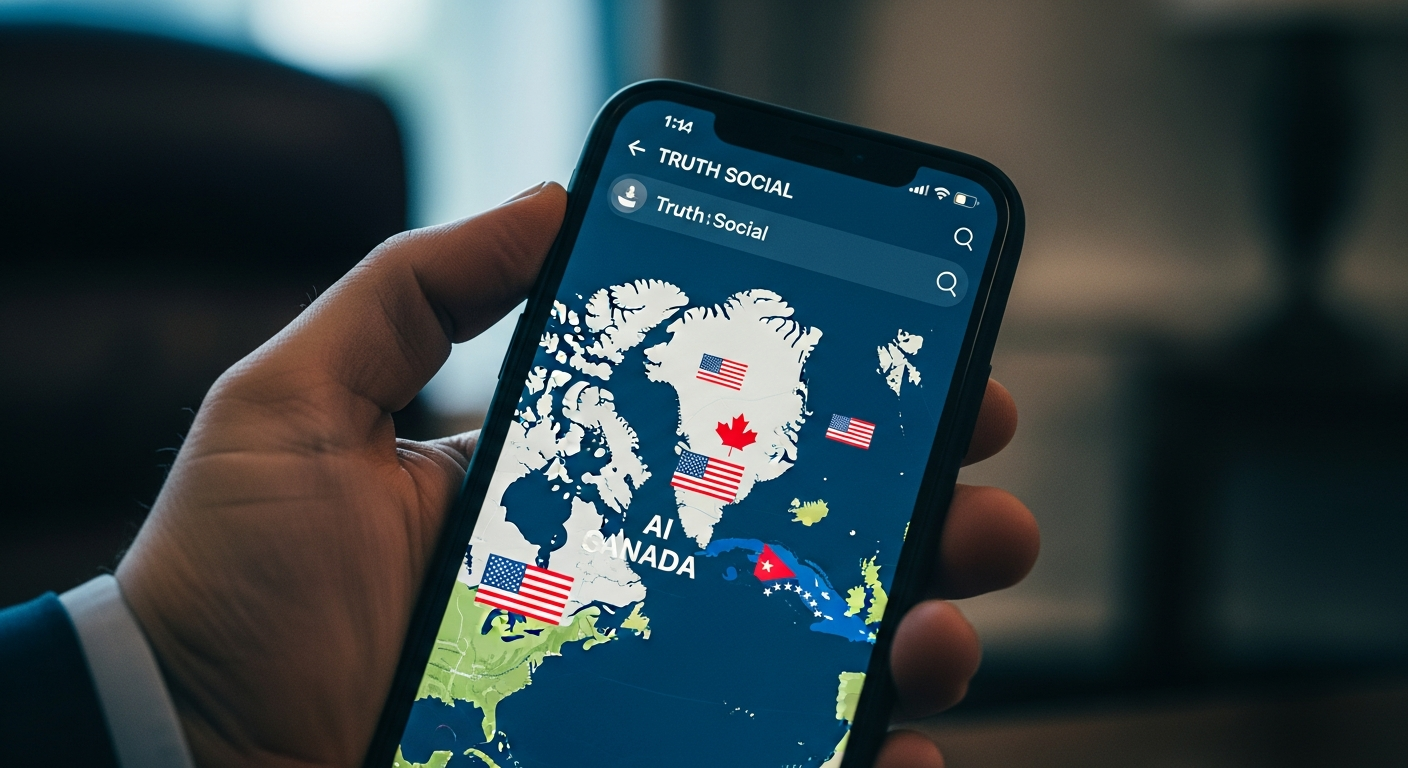
President Trump intensified his rhetoric about acquiring Greenland, employing AI-generated images on Truth Social to depict it and other sovereign nations under the U.S. flag.
-
European leaders, including Ursula von der Leyen and Emmanuel Macron, condemned Trump's tariff threats as "a mistake" and an attempt to "extort territorial sovereignty," questioning U.S. trustworthiness.
-
Canadian Prime Minister Mark Carney expressed "concern" over U.S. rhetoric and reaffirmed Greenland's self-determination with Danish support, highlighting Canada's Arctic defence investments.
-
Macron vowed to use France's G7 presidency to foster international cooperation and resist a "new colonial approach" to global affairs.
-
The escalating dispute at the World Economic Forum underscores significant rifts in transatlantic relations and challenges to established diplomatic protocols.
Digital Diplomacy and Disinformation's New Frontier
President Trump's early morning "posting blitz" on Truth Social represents a jarring evolution in international relations. The deployment of AI-generated imagery — a doctored map showing vast swathes of the Western Hemisphere under the American flag, and a fantastical Oval Office meeting with European leaders — blurs the line between policy discussion and digital propaganda. This isn't merely a gaffe; it's a deliberate, technologically-assisted projection of American ambition that bypasses traditional diplomatic channels and directly challenges global sovereignty. The casualness with which such provocative visuals are shared underscores a dangerous normalization of disinformation as a tool of statecraft, potentially eroding public trust in official communications and further polarizing an already fractured international community.
Geopolitical Chessboard: Greenland and the Arctic
At the heart of Trump's latest grandstanding is Greenland, a strategically vital territory whose future, as reiterated by Canadian Prime Minister Mark Carney and U.K. Prime Minister Keir Starmer, rests solely with its people and Denmark. The Arctic, long a region of fragile peace, is increasingly becoming a flashpoint for geopolitical competition, driven by climate change opening new shipping routes and access to resources. Canada's swift response, including Carney's direct expression of "concern" and emphasis on military investments for Arctic defence, signals the serious security implications of Washington's aggressive posturing. This isn't just about Greenland's landmass; it's about control over critical maritime choke points and resource exploitation in a rapidly changing global environment. The blatant disregard for national self-determination inherent in Trump's vision risks destabilizing the delicate balance of power in the High North.
Tariffs, Trust, and Transatlantic Tensions
The proposed Greenlandic takeover is inextricably linked to Trump's preferred instrument of international coercion: tariffs. European Commission president Ursula von der Leyen correctly labeled these threats as "a mistake," a sentiment echoed by French President Emmanuel Macron, who branded them an attempt to "extort territorial sovereignty." This weaponization of trade against allies, particularly after previous promises to de-escalate trade disputes, fundamentally undermines the bedrock of transatlantic trust. Macron's stark declaration that such actions are "fundamentally unacceptable" and signal a desire to "weaken and subordinate Europe" cuts to the core of European anxieties about America's commitment to multilateralism. The perception that the U.S. is using its economic leverage to dictate territorial changes, reminiscent of colonial-era tactics, is a direct assault on the principles of sovereign equality that underpin the modern international order.
A Unifying Front Against Unilateralism?
Amidst the discord, there are clear signs of a concerted European and Canadian pushback. Macron's pledge to leverage France's G7 presidency to foster cooperation and resist "a new colonial approach" is a potent counter-narrative to Trump's unilateralism. His choice to wear aviator sunglasses, a subtle sartorial nod to former U.S. President Joe Biden, could be interpreted as a deliberate symbolic gesture, signaling a preference for a return to traditional alliances and a more predictable, collaborative global leadership. Similarly, the coordinated readout from the Canadian and U.K. Prime Ministers, reaffirming Greenland's self-determination, demonstrates a unified front against what they perceive as American overreach. These leaders, convening at the World Economic Forum, are not merely reacting; they are actively working to articulate and solidify an alternative vision for global governance, one rooted in cooperation rather than coercion.

Public Sentiment
The international response to President Trump's Greenland gambit has been swift and overwhelmingly critical, characterized by a mix of alarm, defiance, and a reiteration of core principles. Ursula von der Leyen succinctly captured the economic concern, calling Trump's tariff threats "a mistake," highlighting their impact on trust. From Ottawa, Prime Minister Mark Carney voiced a "concerned" perspective on the escalating rhetoric, firmly asserting that "the future of Greenland is up to its people and Denmark." This sentiment was powerfully amplified by French President Emmanuel Macron, who minced no words, stating that U.S. trade agreements are looking to "weaken and subordinate Europe," and unequivocally declared that "accepting a new colonial approach doesn't make sense" when used to extort territorial sovereignty. The consensus among these global leaders is a rejection of both the tactics and the underlying premise of Trump's latest geopolitical maneuver.
Conclusion
President Trump's recent actions, from his social media provocations to his tariff threats, represent more than just a passing diplomatic spat; they are an explicit challenge to the foundational principles of international law, sovereignty, and trust. The coordinated pushback from Canada and Europe, particularly evident at the World Economic Forum, underscores a growing global consensus that such unilateral and coercive tactics are unacceptable. As the "Rusty Tablet" has consistently argued, the erosion of diplomatic norms and the weaponization of both digital platforms and economic policy create a highly unstable international environment. The path forward demands not just condemnation, but a robust commitment from world leaders to re-establish multilateral cooperation and defend the tenets of sovereign equality against an increasingly unpredictable and disruptive force in global politics. The world watches to see if this nascent international solidarity can withstand the sustained pressure from Washington.