
Key Takeaways
-
The Bic Lamp leverages powerful, almost universal nostalgia for a common, everyday object.
-
Its extreme scale (12:1) transforms a mundane item into a design spectacle, challenging traditional notions of utility.
-
The collaboration between an iconic pen manufacturer and a avant-garde design brand highlights blurring lines between industrial design, art, and consumer products.
-
It raises pertinent questions about sustainability, purpose, and the 'why' behind new creations in an era of intentional consumption.
-
Ultimately, the Bic Lamp reflects a broader trend of design engaging with cultural memory, irony, and the inherent theatricality of the built environment.
Main Analysis
Seletti, the Italian design house renowned for its audacious and often playful approach to domestic objects, has once again managed to inject a jolt of irreverence into the staid halls of contemporary design. Their latest offering, the Bic Lamp, a 5-foot, LED-illuminated homage to the humble Bic Cristal pen, debuted at Maison&Objet 2026, forcing attendees and observers alike to confront a question that echoes through every corner of modern consumer culture: when does an icon transcend its utility to become something else entirely?
Nostalgia as Commodity: The Universal Language of the Bic
The Bic Cristal pen is, arguably, one of the most recognizable and widely used objects on the planet. Its transparent barrel, simple cap, and reliable ink delivery have made it an unassuming symbol of education, bureaucracy, and countless hurried notes. It's a design so perfectly minimalist, so inherently functional, that it has achieved a kind of anonymous omnipresence. This ubiquity, this shared cultural memory, is precisely the fertile ground Seletti has chosen to till.
The Bic Lamp taps into a deep well of collective nostalgia. It evokes memories of school desks, exams, doodling in margins, and the sheer democratic accessibility of a tool that costs mere cents. By taking this symbol and inflating it to monumental proportions, Seletti isn't just creating a lamp; they are manufacturing a tangible piece of shared past, scaled up for consumption. The critical question arises: is this a genuine, heartfelt tribute to an enduring design, or a clever, perhaps even cynical, exploitation of sentiment for commercial gain? The very act of transforming an item known for its affordability and disposability into a high-design, presumably premium-priced fixture forces us to consider the commodification of our collective history.
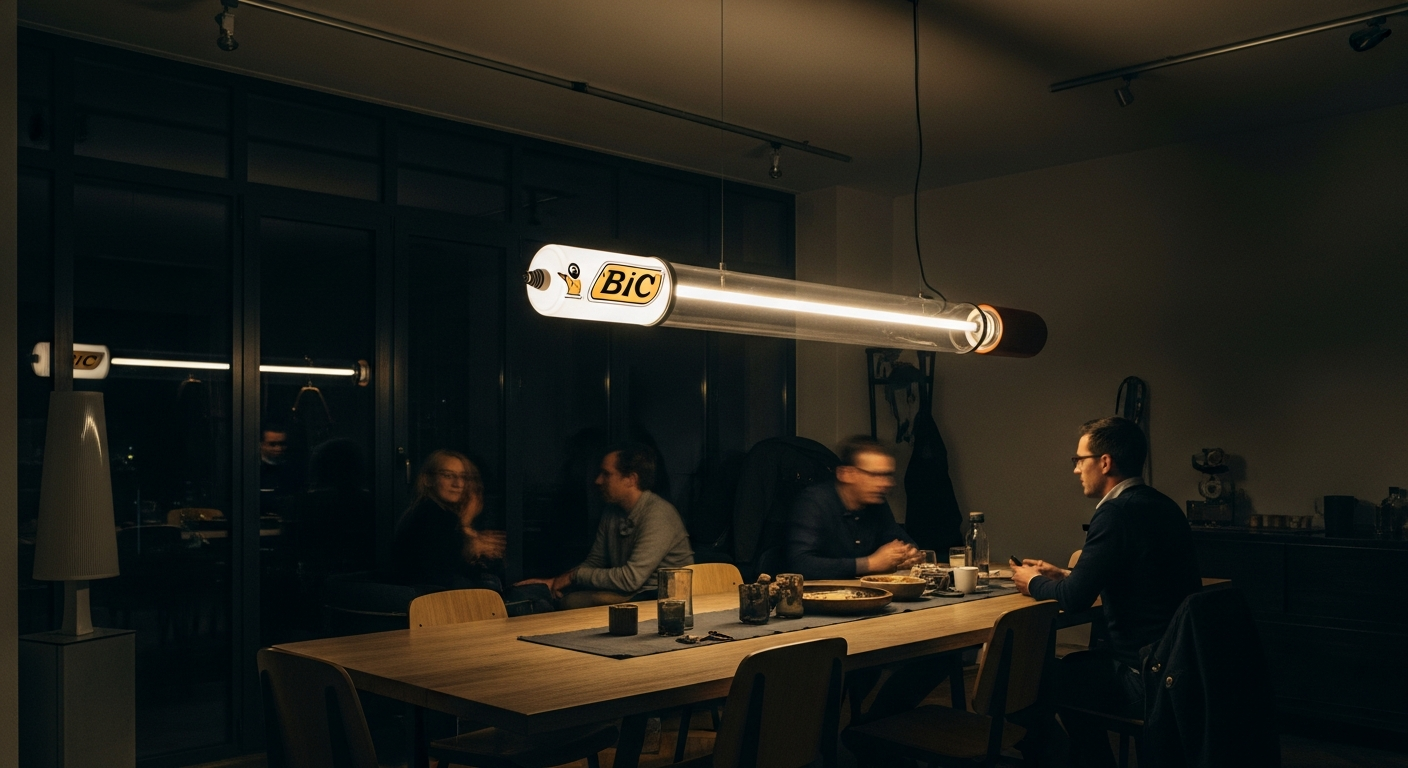
The Scale of Intent: Beyond Function, Towards Spectacle
The most striking aspect of the Bic Lamp is, undoubtedly, its scale. At 12 times the size of its progenitor, it sheds any pretense of practical functionality as a writing instrument. Instead, it embraces its new role as a spectacle. This transformation from a discrete tool to a dominant environmental feature is where the Bic Lamp truly challenges our perceptions of design. It’s no longer just a pen; it’s a monument to a pen.
This deliberate manipulation of scale pushes the object beyond mere utility into the realm of conceptual art or playful sculpture. It demands attention, forcing interaction not just with its light-emitting function, but with its sheer presence. One can imagine it as a conversation starter in an avant-garde lobby, a bold statement in a minimalist living room, or a defiant wink in a hyper-modern office. Yet, this grandiosity also invites scrutiny. Does its dramatic scale merely serve as a superficial visual pun, or does it genuinely elevate the original design, forcing a reconsideration of its innate brilliance? The industrial design world has often grappled with the notion of 'form follows function,' but here, 'form follows narrative' seems a more apt description.

Beyond Utility: Art, Gimmick, or Both?
The Bic Lamp occupies a fascinating, often ambiguous, space between functional lighting, pop art, and marketing brilliance. Is it 'art' in the purest sense, challenging conventional forms and provoking thought? Or is it a 'gimmick,' a fleeting novelty designed for social media virality and little else? The truth, as often happens in design that pushes boundaries, likely lies somewhere in between.
Seletti has a history of blurring these lines, turning everyday objects—from forks to toilet paper—into design statements. The Bic Lamp is a continuation of this tradition, presenting an object that is both undeniably clever and inherently absurd. It’s a design that dares to ask: why not make a giant pen into a lamp? This audacity is precisely what gives it its edge and its capacity to divide opinion. For some, it will be a stroke of genius, a joyful celebration of the mundane elevated to art. For others, it will be a prime example of design excess, prioritizing shock value over genuine innovation or lasting aesthetic merit. In a world grappling with overconsumption and the environmental impact of new products, the Bic Lamp's theatricality also raises ethical questions about sustainable design and the true purpose of creating new objects.
Public Sentiment
Reactions to the Bic Lamp have been predictably polarizing, much like any design that deliberately courts controversy. On one side, enthusiasts laud it as a triumph of playful conceptualism, a witty and audacious reinterpretation that injects humor and personality into interior spaces. "It's a bold statement!" one online commenter enthusiastically posted. "Finally, a lamp that truly lights up the room and sparks conversation." Design critics have praised Seletti's commitment to pushing boundaries, celebrating the lamp's ability to transform a ubiquitous item into a high-impact art piece. They view it as a testament to the power of design to celebrate the overlooked and challenge perceptions.
Conversely, a significant segment of the public and design community views the Bic Lamp with skepticism, if not outright disdain. Critics often label it as an overpriced novelty, a triumph of style over substance, and a symptom of an industry increasingly obsessed with fleeting trends and viral moments. "It's a glorified gimmick, plain and simple," stated another disgruntled commenter. "Clever, perhaps, but entirely impractical and ultimately wasteful." The debate often boils down to whether such an object offers genuine aesthetic or functional value, or merely serves as an ironic gesture, destined for a short lifespan in the fickle world of interior design.