Key Takeaways
-
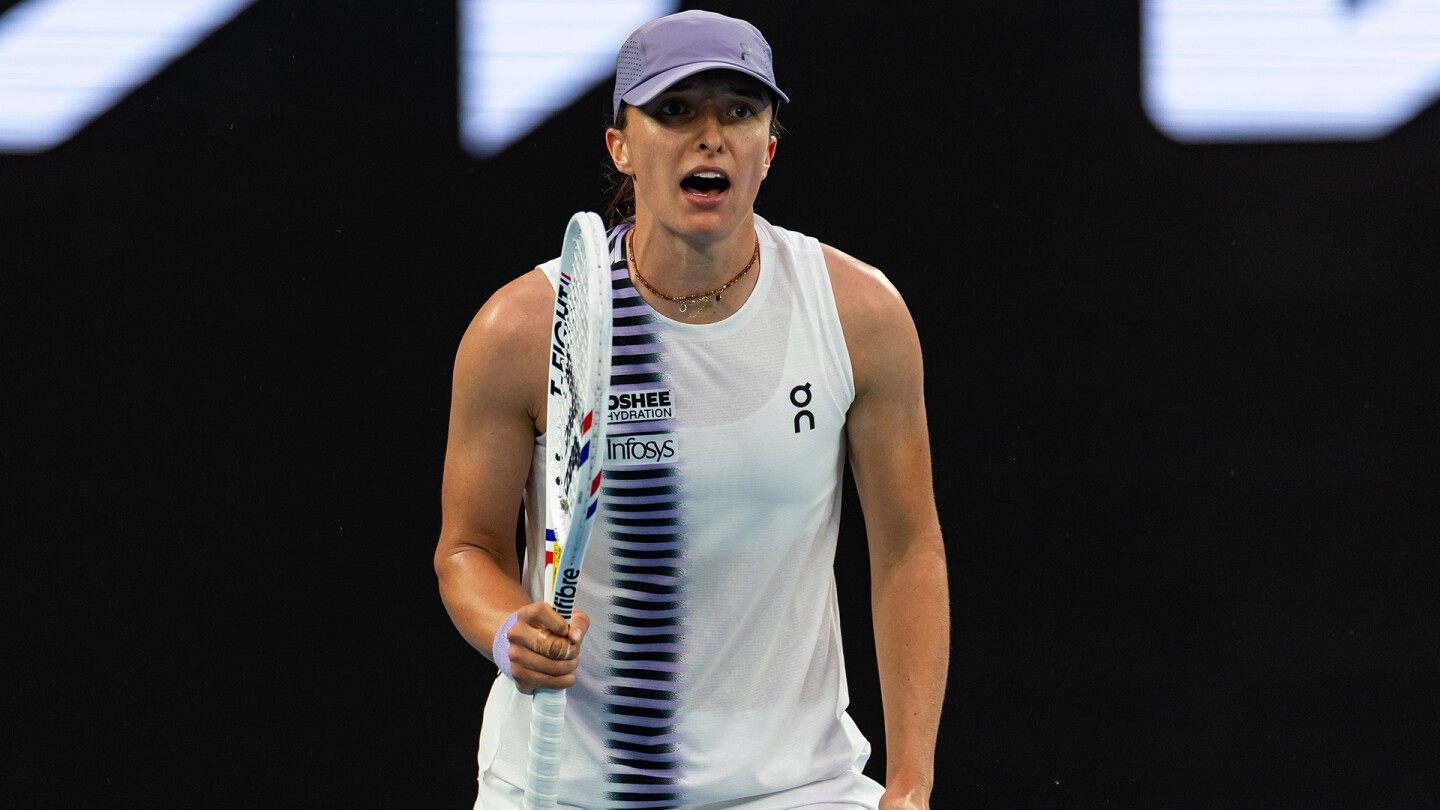
Swiatek's Resilience Tested: World No. 2 Iga Swiatek overcame an early deficit and self-admitted "rust" to advance, highlighting mental fortitude over peak form.
-
Djokovic's Record Trajectory: Novak Djokovic continued his unparalleled run, accumulating multiple all-time Grand Slam and Australian Open records with a dominant first-round win.
-
Top Seeds Navigate Hurdles: Coco Gauff and other high-ranked players faced early challenges, emphasizing the competitive depth even in the initial rounds.
-
Physical Tolls and Early Exits: Several players experienced severe cramping or early departures, underscoring the physical demands of the tournament.
-
Robust Fan Engagement: Record-breaking attendance figures affirm the significant public interest and economic impact of the Australian Open.
Main Analysis
Navigating Early Turbulence: Swiatek and Gauff's Strategic Adjustments
Iga Swiatek's 7-6 (5), 6-3 victory over Chinese qualifier Yuan Yue was less a display of seamless dominance and more a testament to her adaptive capabilities. Swiatek candidly described her performance as "a bit rusty at the beginning," acknowledging "many ups and downs." This candid assessment of her form—marked by a 5-3 deficit in the first set—indicates a significant self-correction requirement. Her ability to force a tiebreaker and ultimately secure the set, followed by a more composed second set, demonstrated a critical shift in her tactical approach: "I needed to get my legs moving. Go after my shots. Be brave with the decisions." This reflects the strategic imperative for top players to adjust on the fly, even when their A-game is elusive.
Similarly, No. 3 Coco Gauff experienced her own opening-day challenges, notably grappling with six double-faults in her first set against Kamilla Rakhimova. Gauff, who recorded a tour-high 431 double-faults last year, acknowledged the issue but maintained composure, stating, "Once I got through that game, I mean, it was pretty much smooth sailing." Both Swiatek and Gauff, contenders aiming for their first Australian Open titles, illustrate that Grand Slam campaigns often commence with performance metrics below optimal, demanding mental resilience and tactical flexibility to progress.
Djokovic's Unyielding Dominance: A Centurion's Trajectory
In stark contrast to the initial struggles of his female counterparts, Novak Djokovic delivered a clinical 6-3, 6-2, 6-2 victory over Pedro Martinez, further cementing his status as a statistical anomaly in professional tennis. The 38-year-old Serb reached several unprecedented milestones: commencing his 21st Australian Open and 81st Grand Slam tournament, while simultaneously securing his 100th win at Melbourne Park. This latter achievement positions him as the first man to record 100 or more wins at three different Grand Slam tournaments, a testament to his sustained excellence and longevity at the sport's highest echelons. Djokovic's concise reaction, "I like the sound of it. Centurion is pretty nice," encapsulates a competitor who not only recognizes but embraces his historical impact. His operational efficiency in this first-round encounter underscores his readiness to pursue an unprecedented 11th Australian Open title and 25th major championship.
Varied Fortunes and Emerging Narratives Across the Courts
Beyond the top-tier contests, the Australian Open's opening rounds offered a mosaic of outcomes. No. 4 Amanda Anisimova, No. 6 Jessica Pegula, No. 8 Mirra Andreeva, No. 17 Victoria Mboko, and No. 25 Paula Badosa all secured straight-set victories, signaling strong starts for several seeded players. However, the tournament also saw significant upsets and physical challenges. 2020 champion Sofia Kenin suffered her fifth consecutive first-round exit at Melbourne Park, falling to fellow American Peyton Stearns. No. 15 Emma Navarro also exited after a three-set loss.
The physical demands of the event were starkly highlighted by the unfortunate exits of Marina Stakusic, who left the court in a wheelchair due to severe leg cramps, and No. 7 Felix Auger-Aliassime, who retired from his match with Nuno Borges for similar reasons. These incidents serve as a potent reminder of the extreme physical conditioning required to compete at this level. On a more sentimental note, 2014 champion Stan Wawrinka commenced what he announced as his farewell season at the Slams with a determined four-set victory, emphasizing his "passion is still intact." Fan engagement also hit record highs, with a combined 101,696 spectators on Monday, surpassing the previous day's record, indicating robust public interest.
Public Sentiment: Player Fortitude and Self-Assessment
The immediate post-match sentiments from the athletes provided a window into their mental states. Iga Swiatek's self-critical yet optimistic outlook — "I was a bit rusty at the beginning... I have some stuff to work on. I'll just focus on that... It's not hard to win matches when everything is going well. Today it wasn't, but I was able to win" — showcased her resolve and pragmatic approach to performance enhancement. Novak Djokovic's succinct, "Centurion is pretty nice," reflects a champion's understated acknowledgment of monumental achievements. Coco Gauff’s perspective on her double-faults, "I mean, it was just the first set... it was pretty much smooth sailing [after that]," indicates a capacity for swift problem-solving and maintaining perspective under pressure. Stan Wawrinka's declaration, "The passion is still intact. Today was amazing. I'm so happy that I won — I have a chance to play one more here," resonates with a veteran's appreciation for the competitive stage. These synthesized quotes collectively paint a picture of professional athletes acutely aware of their performance metrics, dedicated to continuous improvement, and deeply invested in their competitive journeys.
Conclusion
The opening salvo of the Australian Open has offered a comprehensive look at the diverse trajectories of its top competitors. While Novak Djokovic continues his march through the record books with an almost clinical efficiency, the journeys of Iga Swiatek and Coco Gauff illustrate the early tests of resilience, strategic adaptation, and mental fortitude that are often prerequisite for Grand Slam success. As the tournament progresses, the capacity of these athletes to refine their game, manage pressure, and overcome physical demands will be the defining metrics of their campaigns. The high stakes and dynamic narratives established on day one promise an engaging and analytically rich championship ahead.