
The political arena in India, much like a well-oiled industrial complex, consistently churns out debates, accusations, and counter-accusations with relentless efficiency. The recent 'Modi teri kabr khudegi' slogan, rather unceremoniously hurled by a segment of the opposition, was quickly repurposed by Prime Minister Narendra Modi. Instead of merely condemning the sentiment, the PM, with the strategic precision of a seasoned chess master, turned the spotlight onto the very architects of the 'Mohabbat ki Dukaan' slogan, accusing them of peddling animosity under the guise of benevolence. It's a classic political manoeuvre: when someone throws a brick, build a gazebo and invite them to debate its structural integrity.
Key Takeaways:
-
Rhetoric Recycled: Political slogans are not just uttered; they are weaponized, reinterpreted, and then weaponized again with surprising versatility.
-
The Irony Emporium: The concept of a 'Shop of Love' being accused of stocking 'hate' provides a delicious layer of irony, prompting philosophical musings on political marketing.
-
Parliament as Performance Art: India's parliamentary debates continue to evolve into a unique genre of public spectacle, where dramatic pronouncements often overshadow policy discussions.
-
Decoding the Subtext: The public is increasingly adept at sifting through layers of political grandstanding to discern genuine concerns from theatrical flourishes.
The Anatomy of a Slogan: From Grave Digging to Garden Tending
To utter 'Modi teri kabr khudegi' in the charged atmosphere of Indian politics is to invite a storm, not just of condemnation but of calculated counter-strategy. The Prime Minister, never one to shy from a narrative fight, transformed this blunt instrument into an opportunity. By linking the slogan directly to the 'Mohabbat ki Dukaan,' he performed a rhetorical judo throw, using the opposition's own momentum to land a blow. It's a move that suggests: 'You speak of graves, while I speak of shops. But what exactly are you selling in your shop, if not the very sentiments that lead to such declarations?' The implication is clear: beneath the veneer of 'love,' something considerably less harmonious is brewing.
Love for Sale, Hate for Free: An Unsettling Inventory
The 'Mohabbat ki Dukaan' concept, initially presented as a balm for divisive politics, now finds itself under severe scrutiny – not for its ideals, but for its alleged hidden inventory. The Prime Minister's accusation posits that this 'Shop of Love' isn't merely mislabeled; it's actively disguising its true wares. One can almost picture a dimly lit backroom, where instead of freshly baked bread of brotherhood, they're discreetly packaging 'bottled resentment' and 'artisanal animosity.' It's a provocative image, especially in a nation where emotional appeals often dictate political allegiances.
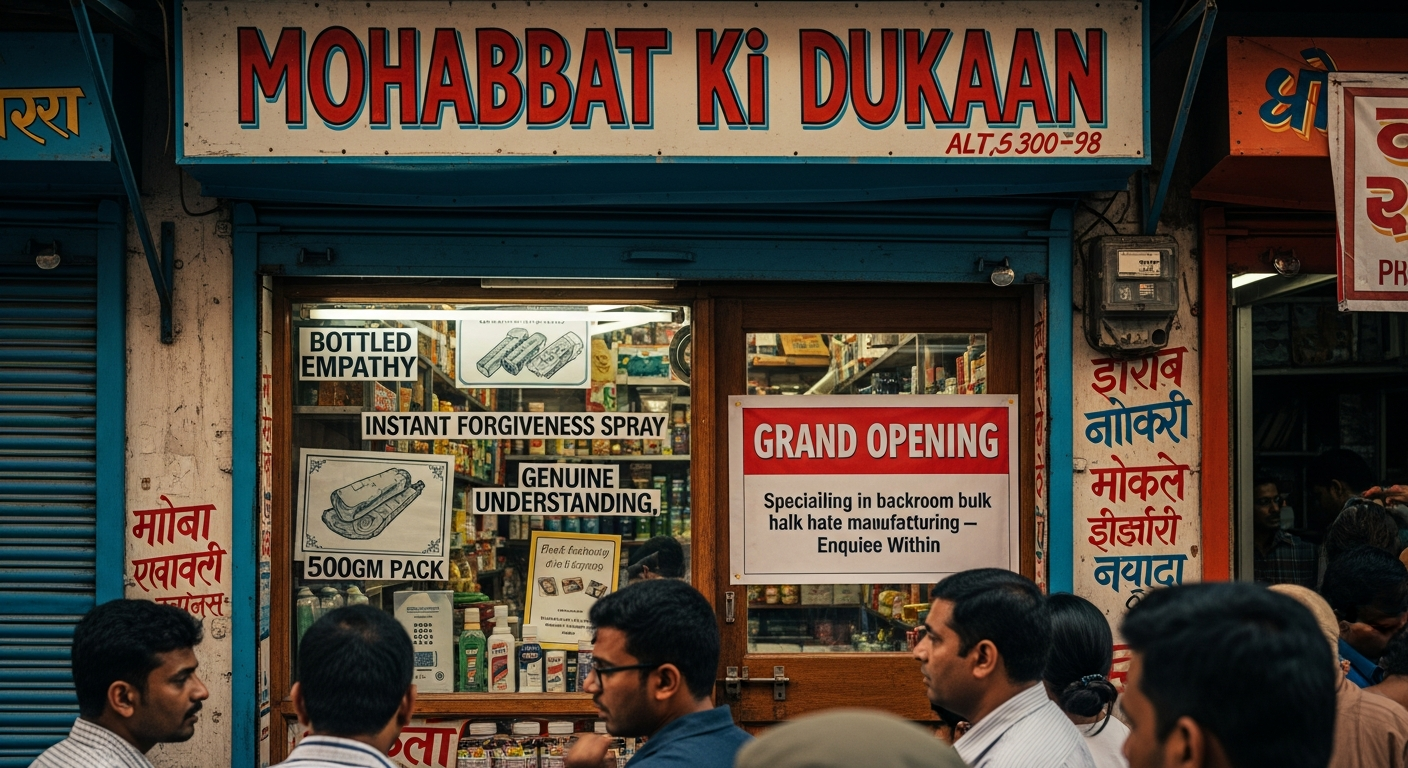
The question then becomes: Is this a genuine critique, or a masterclass in deflection, turning the narrative from the aggressive statement made against him to the perceived hypocrisy of his accusers?
Parliamentary Performance Art: The Rajya Sabha Stage
The Rajya Sabha, often seen as the more deliberative of India's legislative bodies, frequently transforms into a theatrical arena. When the Prime Minister takes the floor to deliver such a pointed accusation, it's less a procedural statement and more a monologue designed for maximum impact. The delivery, the timing, the carefully chosen words – all contribute to a performance intended to resonate far beyond the chambers, into living rooms and social media feeds. This isn't just debate; it's political theatre, where every line is delivered not just to colleagues but to an audience of billions, each with their own critical faculty, or at least, their own favourite memes.
The Irony Meter: Off The Charts or Just Calibrated Differently?
The irony of a political leader accusing others of masking hate behind a façade of love is a rich vein for 'Rusty Tablet' to mine. In an age where political discourse globally is often defined by its polarization and aggressive posturing, the accusation itself becomes a meta-commentary on the state of affairs. Is the 'Mohabbat ki Dukaan' truly a front, or is the accusation itself a strategic manoeuvre to paint opponents with the same brush they often apply to others? The irony meter, in India's political landscape, often oscillates wildly, sometimes even breaking, leaving analysts and citizens alike to ponder the true intentions behind the carefully crafted rhetoric. It's a complex dance of accusations and counter-accusations, where the truth often becomes another commodity in the grand bazaar of public opinion.
Public Sentiment: A Cacophony of Chuckles and Concern
Across the vast expanse of India, public sentiment ranges from cynical amusement to exasperated concern. "First they dig graves, then they sell love – sounds like a weekend market run by a goth poet!" quipped a Mumbai commuter. A Delhi intellectual mused, "It's less about love or hate and more about who controls the narrative supply chain." Meanwhile, a farmer in Punjab simply shrugged, "More drama for the television. We're still waiting for our crops to get a fair price, regardless of what's sold in whose 'dukaan'." The underlying thread? A growing public weariness with the theatrics, combined with an undeniable fascination with the spectacle.
Conclusion: The Perennial Search for Substance Amidst the Shouts
The 'Mohabbat ki Dukaan' controversy, sparked by the 'kabr khudegi' comment, is more than just a passing skirmish. It's a potent symbol of India's political discourse: vibrant, dramatic, and often deeply ironic. While the accusations fly and the slogans resonate, the underlying question for the discerning citizen remains: Amidst the shops of love and the threats of graves, what genuine policy and progress are being offered? Perhaps the true 'Rusty Tablet' analysis is that in this grand bazaar of beliefs, what's often missing is not passion, but simply, a clear price tag on tangible change. And until then, the show, in all its satirical glory, must go on.