Key Takeaways:
-
Presidential unilateralism met the immovable object of federal law, proving that even the most 'sweeping' of intentions can be swept aside by nine robed individuals.
-
The Supreme Court, in a stunning display of jurisprudential efficiency, managed to rule without once consulting 'Lenny Skutnik', whose elusive identity continues to vex the collective consciousness.
-
Global tariffs, much like a poorly constructed artisanal cheese board, have been declared legally unsound, likely sending economists scrambling for new, less aggressive culinary metaphors.
-
The true cost of international trade disputes might just be the sheer cognitive dissonance required to follow them, especially when unexpected historical footnotes emerge.
The Curious Case of Mr. Skutnik and the Court
The digital airwaves, ever a beacon of clarity, recently posed a profound question: "What is a 'Lenny Skutnik'?" This query, shimmering briefly in the algorithmic ether, somehow found itself juxtaposed against news of the Supreme Court's latest pronouncement on presidential tariffs. One might assume that Mr. Skutnik (if indeed he is a 'Mr.' and not, say, a particularly obscure legal precedent or a brand of artisanal wrench) played some pivotal role in the proceedings. Perhaps he was an amicus curiae, a forgotten constitutional scholar, or simply the only person in Washington with a fully operational abacus. Alas, the official record, much like a heavily rusted cog, yields no such easy answers.
Yet, the very appearance of his name, like a rogue rivet in the machinery of serious journalism, highlights a greater truth: in a world grappling with complex legal intricacies and the delicate dance of global trade, sometimes the most pressing question isn't about the letter of the law, but about the very foundations of public attention itself. Is it possible that the public, weary of tariff wars and judicial review, yearns for the simple, reassuring solidity of a 'Lenny Skutnik' – whatever, or whoever, that may be?
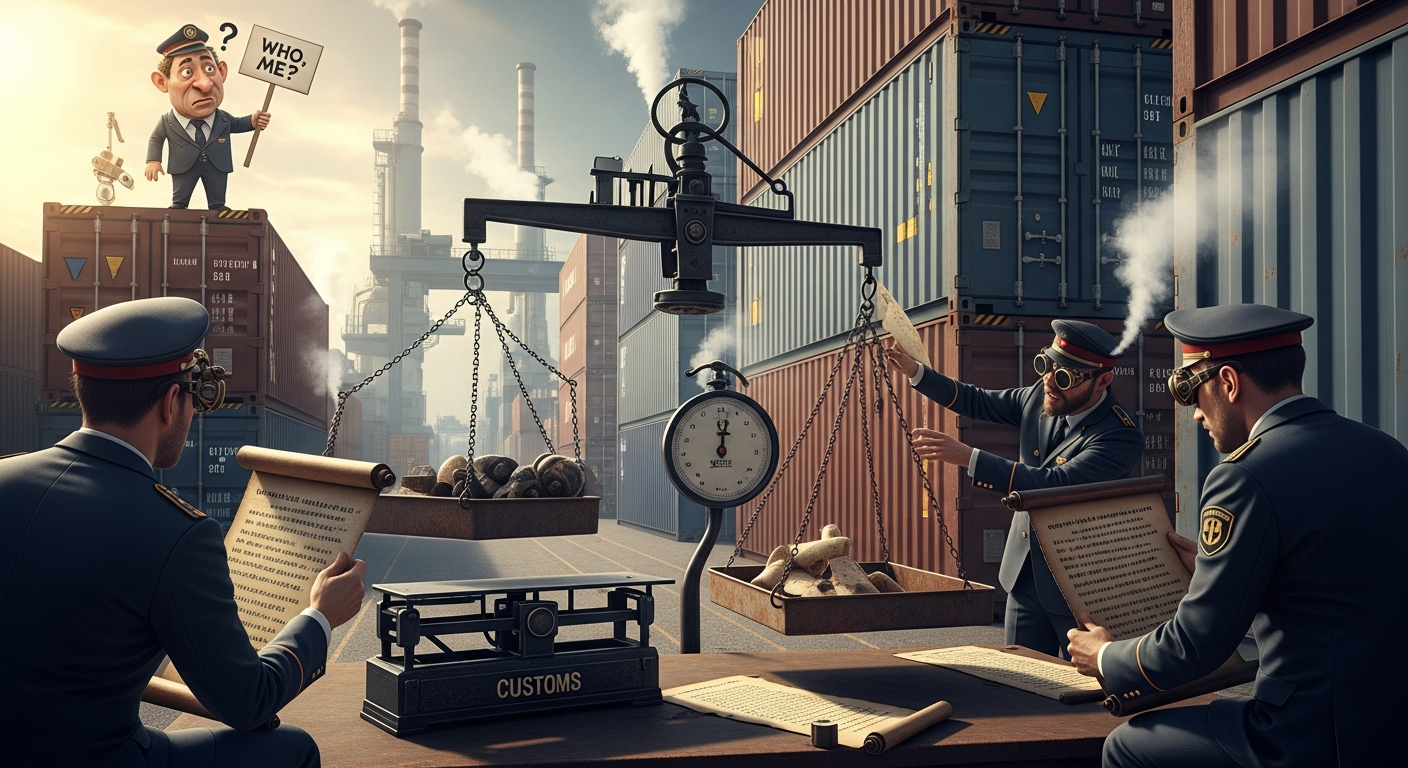
Roberts, The Roberts, and the Robe: A Performance of Power
In a scene less about dusty tomes and more about theatrical gravitas, Chief Justice John Roberts, architect of the majority opinion, descended from his judicial perch to articulate the Court’s decision. Imagine, if you will, the palpable tension in the room – not unlike a precision-engineered automaton winding down after a particularly strenuous task. Roberts, known for his methodical delivery and subtle inflections, reportedly delivered the verdict with the crisp authority of a well-oiled stamping press, each word a carefully calibrated blow against executive overreach.
According to CNN’s chief Supreme Court analyst Joan Biskupic, Roberts meticulously dismantled the administration's legal scaffolding, revealing it to be structurally unsound under the weight of federal law. He wrote, one imagines, with the unflinching gaze of a master craftsman inspecting a faulty component, noting with surgical precision where the welds had failed and the design flaws had become critically apparent. The message was clear: presidential ambition, however 'sweeping', must still fit within the established tolerances of statutory authority.
Tariffs: A Blunt Instrument, Now Blunted
For an administration that championed the unilateral imposition of 'sweeping tariffs' as a cornerstone of its foreign policy and economic agenda, the Supreme Court's ruling must have landed with the metallic clang of a dropped wrench. The Court found President Donald Trump to have 'violated federal law' – a phrase that, in judicial parlance, translates roughly to 'you really shouldn't have done that.' This wasn't merely a polite suggestion; it was a constitutional reprimand, delivered with the full force of the nation's highest judicial body.
The implications for trade policy are, predictably, 'sweeping' in their own right. The ruling effectively clips the wings of future presidents who might eye similar executive bypasses of legislative authority when it comes to international commerce. It affirms that the proper mechanism for such significant economic shifts is through the laborious, often frustrating, but ultimately democratic process of Congress. One can almost hear the collective sighs of relief from importers and exporters, now free from the arbitrary imposition of duties, and the collective groans from White House strategists, whose 'unilateral' button has just been permanently disabled.
The Correction: A Testament to Precision, or Lack Thereof
And finally, in a poignant nod to the fallibility of even the most rigorous information pipelines, a small but significant detail emerged: "Correction: A previous version of this video misstated the amount of money generated by Trump's emergency tariffs." In the grand scheme of legal battles and global economics, a misstated figure might seem minor. Yet, in the 'Rusty Tablet' newsroom, where accuracy is as revered as a perfectly machined bolt, such a correction underscores the sheer complexity of the modern information landscape.
One might wonder if the initial misstatement was inadvertently influenced by a public still grappling with the 'Lenny Skutnik' phenomenon, leading to a kind of generalized numerical dyslexia. Or perhaps, the sheer, mind-boggling scale of the tariffs themselves made accurate tabulation a Sisyphean task. Either way, the correction serves as a humble reminder: even when the highest court clarifies the law, the data often requires a second, third, and sometimes fourth pass through the computational crucible.
Public Sentiment: A Cacophony of Confusion and Clarity
-
"So, you're telling me we can't just slap tariffs on things willy-nilly? Who knew? I thought that was the whole point of having a President! And what about Lenny? Is he still waiting for his call?" – Brenda from Boise, Retired Welder
-
"This ruling is a crucial reaffirmation of the separation of powers. A President's authority, however robust, is not boundless. It reinforces the meticulously constructed framework of our republic. Frankly, the 'Lenny Skutnik' distraction is symptomatic of a broader societal decline in focus." – Dr. Alistair Finch, Jurisprudence Ethicist
-
"Another day, another blow to executive action. Feels like the Supreme Court's just playing a very expensive game of 'Whac-A-Mole' with policy. Meanwhile, my widget prices are still through the roof. Can 'Lenny Skutnik' do anything about that?" – Marcus 'Mick' O'Malley, Small Business Owner
Conclusion
The Supreme Court's decision to curb presidential tariff powers stands as a robust reaffirmation of federal law and the delicate balance of governmental authority. It's a testament to the fact that even the most ambitious executive actions must eventually pass muster under the cold, analytical gaze of the judiciary. As for 'Lenny Skutnik'? His identity remains shrouded in the mists of anecdotal ambiguity, a perennial question mark in the grand lexicon of public discourse. Perhaps, in a world obsessed with the heavy machinery of state, the true genius lies not in providing answers, but in posing the questions no one quite expects, reminding us that even amid the gravitas of a Supreme Court ruling, there's always room for a little well-placed enigma. And possibly, a well-oiled abacus. Though probably not 'Lenny Skutnik.'