Key Takeaways
-
Iran's top security official, Ali Larijani, claims "progress" in forming a negotiation structure with the US, despite escalating rhetoric.
-
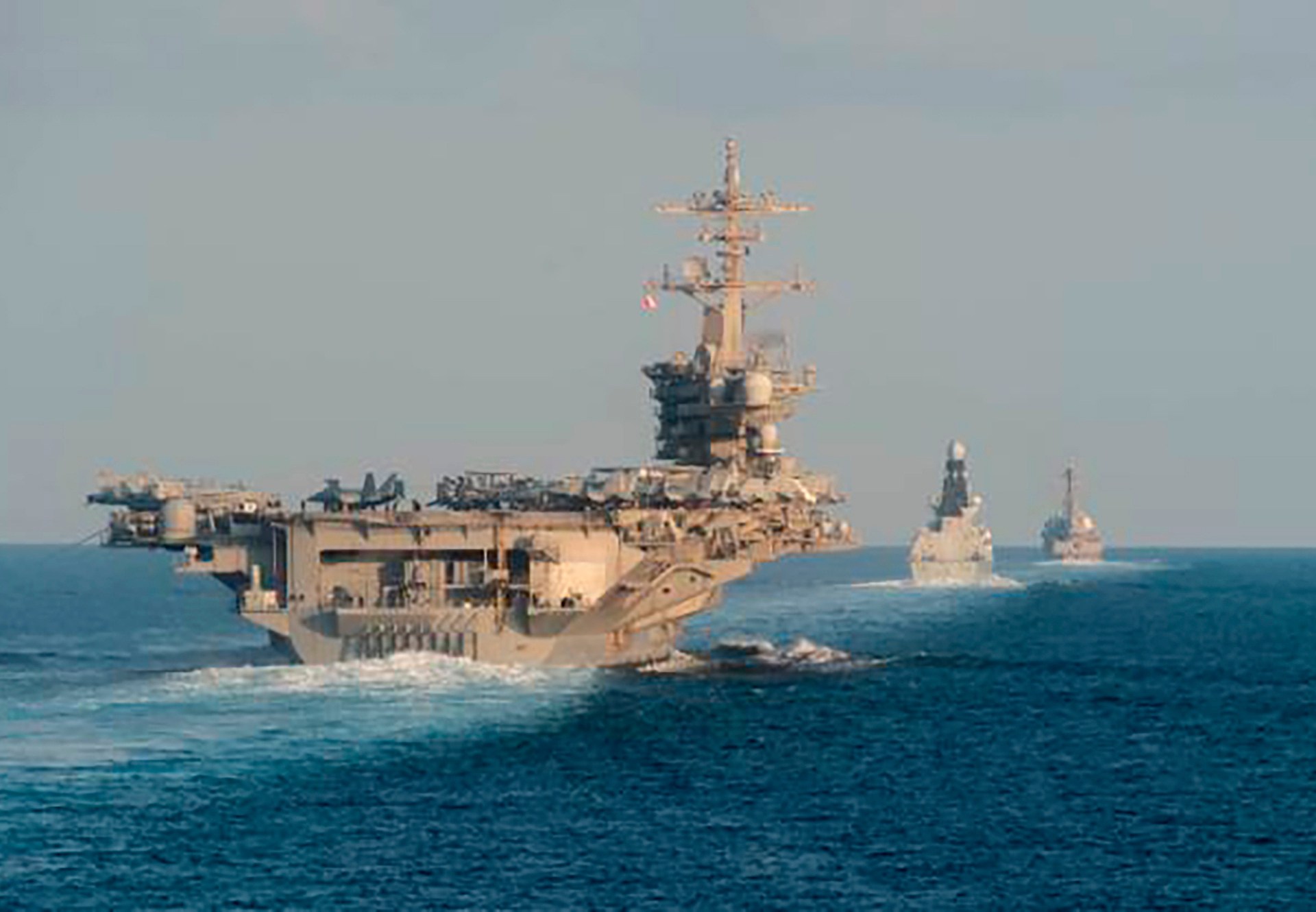
The US has deployed a significant naval presence, including the USS Abraham Lincoln, increasing fears of military confrontation.
-
Both nations have exchanged sharp warnings regarding military exercises in the Strait of Hormuz, a vital global trade passage.
-
Qatar is actively mediating, with its Prime Minister meeting Iranian officials to discuss de-escalation.
-
The US designation of Iran's IRGC as a terrorist organization complicates diplomatic and military interactions.
Fragile Diplomacy Amidst Belligerence
In a period marked by heightened US-Iran tensions, a rare, albeit vague, signal of diplomatic movement has emerged from Tehran. Ali Larijani, the head of Iran's Supreme National Security Council, asserted in a recent social media post that "the formation of a structure for negotiations is progressing." This declaration, however, arrived devoid of specific details regarding the purported framework, leaving observers to parse its implications against a backdrop of increasing military posturing.
Weeks of rising tensions have seen US President Donald Trump issue repeated threats against Iran, primarily concerning a crackdown on anti-government protests and efforts to curtail Iran's nuclear program. Concurrently, the Trump administration has deployed a formidable naval "armada" to the region, spearheaded by the USS Abraham Lincoln aircraft carrier, significantly amplifying fears of a potential military confrontation.

Senior Iranian leaders have consistently voiced an openness to dialogue with Washington, contingent upon the cessation of US threats. This condition was recently challenged when President Trump stated that US vessels in the region were prepared to use "violence, if necessary" should Iran decline nuclear program talks. The juxtaposition of these statements — a nascent diplomatic gesture from Tehran against explicit threats of force from Washington — illustrates the extremely delicate and uncertain nature of the current geopolitical climate.
The Strait of Hormuz: A Flashpoint
The strategic Strait of Hormuz has quickly become a focal point for the escalating tensions. US Central Command (CENTCOM) issued a stern warning to Iran's Islamic Revolutionary Guard Corps (IRGC) regarding its planned two-day naval exercise in the critical maritime passage. CENTCOM underscored that "Any unsafe and unprofessional behavior near US forces, regional partners or commercial vessels increases risks of collision, escalation, and destabilization."
In a sharp retort, Iranian Minister of Foreign Affairs Abbas Araghchi criticized the US military's presence off Iran's shores, accusing CENTCOM of attempting to dictate the conduct of Iran's armed forces on their own territory. Araghchi also highlighted the paradox of CENTCOM requesting "professionalism" from the IRGC, which the US designated as a "terrorist organization" in 2019. This designation, he argued, created an untenable situation where the US simultaneously acknowledged the IRGC's right to conduct drills while branding it as a terrorist entity. Araghchi further contended that the presence of external forces invariably leads to escalation rather than de-escalation, a sentiment echoed by Al Jazeera's Tohid Asadi, who described the situation as "quite fragile and delicate" from Tehran.
Official Rhetoric and De-escalation Efforts
The diverse official statements emanating from Washington, Tehran, and regional capitals paint a picture of conflicting objectives and the intense pressures at play.
-
Iran (Larijani): Hints at structured progress towards negotiations, suggesting a desire for dialogue despite external pressures.
-
Iran (Araghchi): Expresses defiance and strong condemnation of US military actions and rhetorical contradictions, emphasizing national sovereignty and casting foreign presence as destabilizing.
-
United States (Trump/CENTCOM): Threatens military action if diplomatic efforts fail, coupled with cautionary warnings regarding Iranian military activities, signalling a firm stance and a readiness for intervention.
-
Qatar: Actively supports and facilitates diplomatic efforts aimed at reducing tensions, advocating for peaceful solutions and regional stability through coordination with allies.
Amidst this volatile backdrop, diplomatic channels are evidently being pursued. Asadi noted that "Diplomatic [efforts] are [on]going," with Iranian officials engaging allies to avert a confrontation. The Qatari Ministry of Foreign Affairs confirmed that Prime Minister Sheikh Mohammed bin Abdulrahman bin Jassim Al Thani met with Larijani in Tehran to discuss "efforts to de-escalate tensions in the region." Sheikh Mohammed reiterated Qatar's commitment to reducing tensions and achieving peaceful solutions, stressing the need for concerted efforts and diplomatic resolution of differences.
Conclusion
The current state of US-Iran relations is a complex weave of escalating military presence and nascent diplomatic overtures. While a senior Iranian official's statement about progress in negotiations offers a glimmer of hope, it remains uncorroborated by concrete details. This uncertainty is exacerbated by the continued exchange of threats and the significant military buildup in the Gulf. Regional mediation, particularly from Qatar, highlights the international community's profound concern over the potential for miscalculation. The path forward demands cautious de-escalation and genuine commitment to dialogue from all parties to prevent a volatile situation from spiralling into open conflict. [FEATURED]