
The Halo Act: A Necessary Shield or a Slippery Slope for First Responder Safety in Indiana?
[FEATURED]
The Senate Veterans, Military Affairs and Public Protection Committee recently advanced Senate Bill 104, dubbed the 'Halo Act,' a legislative effort spearheaded by Sen. Matt Nunn, R-Sadieville. This bill proposes the creation of a 25-foot safety barrier around first responders as they perform their official duties. On its face, the bill champions a cause few would dispute: the paramount safety of the men and women who rush towards danger when others flee. However, beneath this commendable objective lies a complex tapestry of practical challenges, legal ambiguities, and potential public friction that demands careful consideration.
Key Takeaways:
-
The Halo Act's Core: Aims to establish a 25-foot safety zone around first responders during active duties to enhance protection.
-
Noble Intent, Complex Reality: While universally supported for its protective goals, the bill faces significant questions regarding its practical application across diverse Indiana environments.
-
Enforcement Challenges: Defining and enforcing a dynamic 25-foot barrier in real-time presents considerable hurdles for law enforcement and the public.
-
Public Awareness: Effective public education will be crucial to prevent accidental violations and foster understanding, not resentment.
-
Broader Precedent: The legislation sets a precedent for defining public space and interaction with emergency personnel, inviting scrutiny on future mandates.
Main Analysis: Drawing a Line in the Dust
The Noble Shield, The Tangled Reality
The premise of the Halo Act is intuitively appealing: give our first responders the space they need to operate safely, free from immediate threats or accidental interference. The tragic incidents where first responders have been injured or killed due to proximate traffic or civilian actions underscore the urgent need for enhanced protection. A 25-foot radius, in theory, provides a substantial buffer, allowing responders to focus on the emergency at hand without constantly monitoring their immediate periphery.
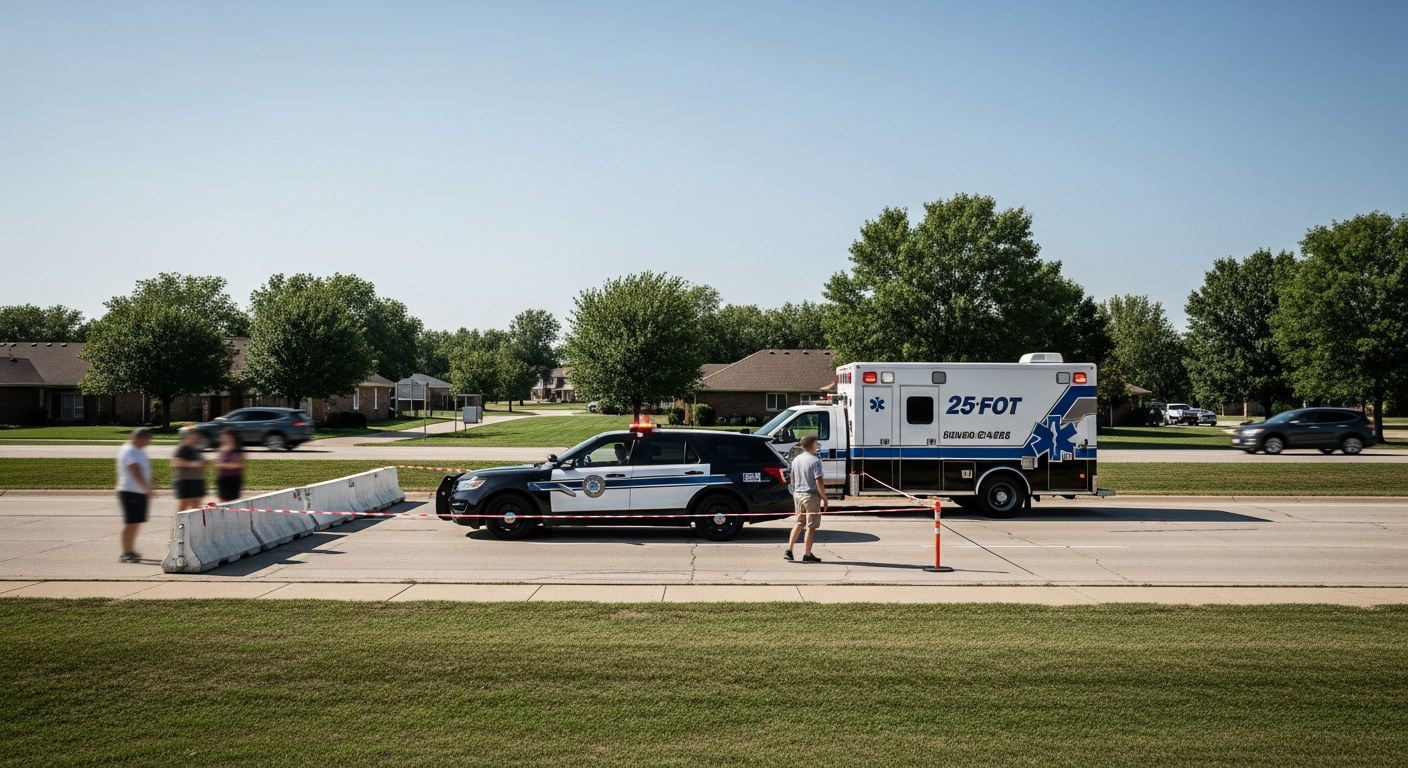
However, the practicality of maintaining such a 'halo' across Indiana's varied landscapes presents a formidable challenge. Consider a multi-lane highway incident: a 25-foot perimeter could easily encompass multiple lanes of traffic, necessitating extensive road closures and significantly impacting commuter flow. In densely packed urban environments, like the bustling streets of Indianapolis or Fort Wayne, a 25-foot barrier around an ambulance attending to a medical emergency could effectively shut down entire intersections, creating gridlock and potentially hindering other emergency responses. Rural settings, with their often-narrow roads and limited shoulders, offer similar, if less congested, dilemmas. The spirit of the law is clear, but its physical manifestation risks becoming a logistical quagmire.
Enforcement: A New Line in the Sand?
Perhaps the most pressing question revolves around enforcement. How will this 25-foot barrier be identified, communicated, and policed in real-time? Will it require emergency personnel to deploy physical markers or rely solely on an implicit understanding from the public? What constitutes a 'violation' of this ephemeral boundary? An unknowing pedestrian cutting too close? A driver inching forward to see past an obstruction? The subjective nature of a dynamic, invisible barrier opens the door to potential disputes and inconsistent application.
Indiana prides itself on a common-sense approach to law, yet the Halo Act, as currently framed, risks creating a new category of 'accidental offenders.' The burden of proof, the process for issuing citations, and the penalties for infringement are critical details that must be meticulously defined. Without clear guidelines, enforcement could be seen as arbitrary, eroding public trust rather than fostering a cooperative environment where safety is a shared priority. It’s not enough to legislate a boundary; we must also legislate its clear, equitable application.

Public Awareness and the Accidental Offender
For the Halo Act to be truly effective, it demands an unprecedented level of public awareness and immediate recognition. Unlike 'move over' laws for stopped emergency vehicles, which are more easily understood and visually identifiable, a dynamic 25-foot perimeter around active personnel requires constant vigilance from the public. How will citizens be educated about this new requirement? Will signage be deployed? Public service announcements? And what about those moments of high stress or urgency, where individuals might inadvertently breach the zone while trying to assist, egress, or simply navigate a chaotic scene?
Indiana's diverse population, including tourists and new residents, will all need to grasp this concept quickly. The potential for good-faith citizens to become 'offenders' through ignorance or momentary lapses of judgment is high. This isn't merely about imposing a rule; it's about shifting public behavior and perception around emergency scenes – a monumental undertaking that requires more than just legislative decree.
Broader Implications: Safety, Freedom, and Precedent
The Halo Act, while focused on first responder safety, inadvertently touches upon broader themes of individual freedom and public access to shared spaces. A 25-foot 'no-go' zone, while temporary, represents a significant curtailment of movement. While most citizens are willing to cede space for legitimate emergency operations, the arbitrary nature of the 25-foot dimension, and its blanket application, might feel excessive in certain low-risk scenarios.
Furthermore, this legislation sets a precedent. If a 25-foot barrier is deemed necessary for first responders, what about other essential workers operating in potentially hazardous public spaces? Construction crews, utility workers, or even public health officials during an outbreak – where does the establishment of such 'halos' end? The thoughtful expansion of safety protocols is crucial, but it must be balanced against the practicalities of a functioning society and the inherent give-and-take of public interaction.
Public Sentiment: A Spectrum of Support and Skepticism
Initial reactions from across Indiana suggest a bifurcated public sentiment. First responder associations and their families have voiced strong support, understandably prioritizing the safety of their loved ones. "Any measure that keeps our officers, firefighters, and EMTs safer is a step in the right direction," commented one representative from a state police benevolent association. "They put their lives on the line daily; we owe them every protection." This sentiment resonates deeply within communities that have seen the sacrifices made by emergency personnel.
However, ordinary Hoosiers, particularly those who frequently commute or live in urban areas, express a mix of understanding and apprehension. "I get it, they need space," remarked a downtown Indianapolis resident. "But 25 feet? On Mass Ave, that's half the street! How's that even going to work without causing massive backups every time there's a fender bender?" Drivers, in particular, voiced concerns about accidental violations and the potential for hefty fines, especially if the boundaries aren't clearly marked or easily understood. Legal experts have also weighed in, highlighting potential challenges related to due process and the interpretation of a dynamic safety zone, suggesting that while the intent is good, the execution requires significantly more clarity to avoid legal quagmires.
Conclusion: A Vision Requiring Refinement
Senate Bill 104 is born from a sincere desire to protect those who protect us. The core objective of enhancing first responder safety is unassailable. However, for the 'Halo Act' to truly serve its purpose without inadvertently creating new problems, its implementation details require rigorous re-evaluation. The 25-foot mandate, while offering a clear numerical target, needs nuanced application guidelines that account for Indiana's diverse environments and varying emergency scenarios. Public education cannot be an afterthought; it must be an integral, ongoing component of this legislative effort.
As the bill moves forward, the "Rusty Tablet" urges lawmakers to engage in a deeper dialogue with not only first responders but also traffic engineers, urban planners, legal scholars, and, most importantly, the everyday Hoosiers who will navigate this new safety landscape. A 'halo' of protection for our heroes is indeed a noble goal, but it must be one that is practical, clearly understood, and equitably enforced, ensuring that it genuinely safeguards lives without unduly complicating the lives it aims to serve.