Key Takeaways:
-
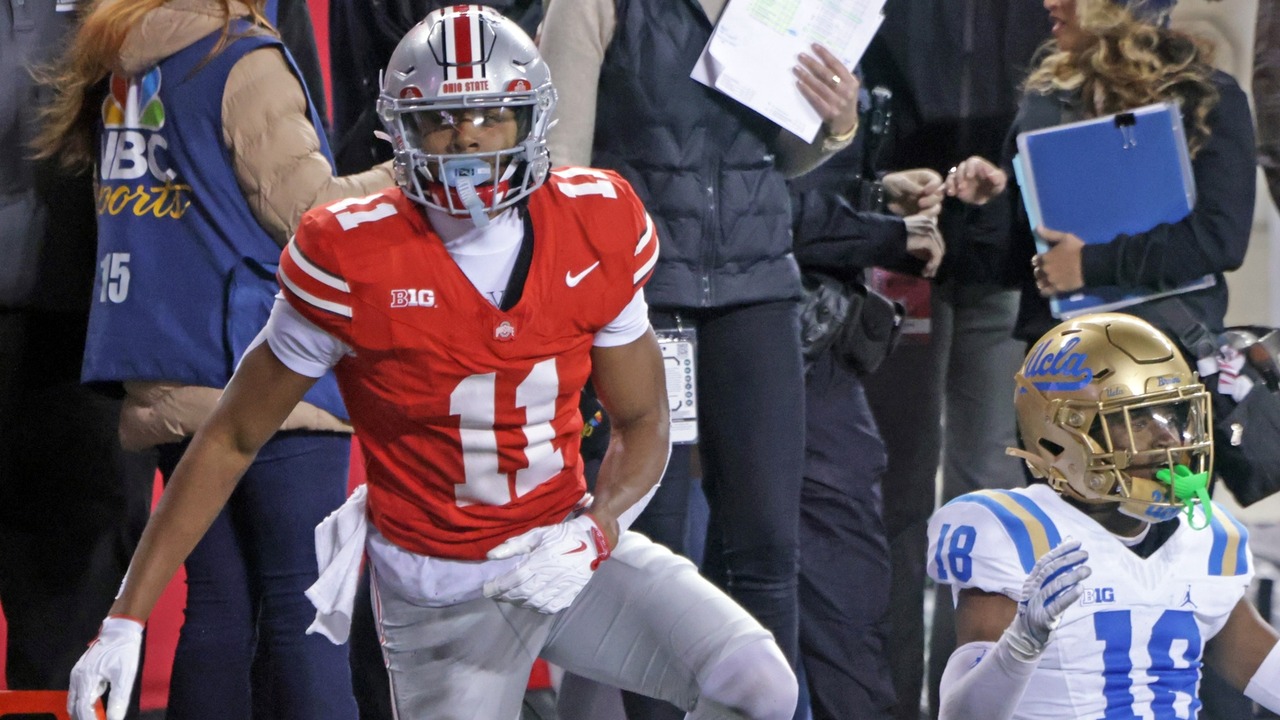
Quincy Porter, a former five-star wide receiver, transferred from Ohio State to Notre Dame after one season.
-
His freshman year saw limited production despite immense high school success.
-
The move underscores the intensified role of the NCAA transfer portal in college football.
-
Notre Dame acquires a player with undeniable raw talent but also inherits the immense pressure of his high-profile status.
-
The saga highlights the commercial realities and fluid player mobility characteristic of modern collegiate sports.
The Unforgiving Spotlight of Promise
Quincy Porter arrived at Ohio State draped in the kind of hype few young athletes ever experience. Hailing from Bergen Catholic, he was not just a local star but a national 'five-star' prospect, crowned NJ.com's 2023 Offensive Player of the Year. His high school statistics read like fiction: 145 catches, an astonishing 2,378 yards, and a staggering 41 touchdowns. Such numbers paint a picture of a generational talent, destined for immediate collegiate stardom. Yet, the brutal reality of top-tier Division I football often clashes with pre-collegiate prophecy. In his freshman year at Ohio State, Porter managed a mere four receptions for 59 yards, a modest return for a player of his calibre and expectation. This chasm between anticipated impact and immediate output is a common, often heartbreaking, narrative for even the most gifted athletes entering the unforgiving crucible of the collegiate game.
The Portal's Double-Edged Sword
Porter’s decision to enter the transfer portal after just one season speaks volumes about the current landscape of American college football. The transfer portal, a relatively recent innovation, has transformed player mobility, offering a lifeline to those seeking new opportunities, a fresh start, or simply more playing time. For a player like Porter, who clearly possesses immense talent but found himself buried on Ohio State's deep depth chart – a programme renowned for producing NFL-calibre wide receivers – the portal represents a viable escape hatch. Yet, it's a double-edged sword. While it empowers athletes, it also exposes them to constant scrutiny and the perpetual pressure to perform or face the prospect of moving on. For programmes, it creates a near-constant recruiting cycle, with rosters in flux and team chemistry a delicate balance.

This isn't just about seeking more snaps; it's often about finding a 'better fit' or a system that can immediately maximise one's unique skillset.
Notre Dame's Calculated Bet
Notre Dame’s acquisition of Porter is a shrewd, calculated gamble. What do the Fighting Irish stand to gain? A player with undeniable raw talent, a history of explosive playmaking from Bergen Catholic, and the pedigree of a five-star recruit. They are betting on a fresh start unlocking the potential that was perhaps stifled in a crowded Ohio State receiver room. For a programme steeped in tradition but consistently searching for that elusive edge to return to national championship contention, bringing in high-calibre talent via the portal is a necessary strategic move. However, the risks are inherent. Notre Dame is taking on a player who, despite his accolades, couldn't immediately crack the rotation at his previous institution. The pressure on Porter will be immense to justify this faith and the hype that inevitably follows him. It’s a high-reward, moderate-risk scenario, emblematic of modern recruiting tactics.
The Marketisation of Talent
Porter's transfer saga is more than an isolated incident; it's a stark illustration of the ongoing marketisation of talent within collegiate sports. These young athletes, still nominally 'amateurs,' operate within a system that increasingly mirrors professional leagues. Factors beyond mere academic pursuit or institutional loyalty now heavily influence decisions. While Name, Image, and Likeness (NIL) deals are not explicitly cited in Porter's case, they form an ever-present backdrop, adding another layer of complexity and financial consideration to player choices.

This is professional sports in all but name, played by an itinerant workforce of highly skilled, highly sought-after individuals. The 'collegiate carousel,' as it's often dubbed, spins ever faster, driven by competition, capital, and the unyielding desire for victory.
Public Sentiment
Across the Atlantic, the ongoing spectacle of American college football transfers often elicits a mixture of fascination and bewilderment. Public sentiment frequently coalesces around a few key observations:
-
"It's a bewildering spectacle, this American college football. They call them students, but they're traded like commodities on some kind of high-stakes exchange."
-
"Another one gone in search of greener pastures. Shows you how much 'loyalty' means when the stakes are this high, especially for a young lad."
-
"That's a lot of pressure for a young lad, isn't it? From a 'five-star' to a freshman benchwarmer, then off to another behemoth. It's a brutal business."
Conclusion
Quincy Porter’s move to Notre Dame is a testament to both his resilience and the relentless churn of talent in the modern collegiate football machine. It underscores the immense pressures placed upon young athletes, the transient nature of 'loyalty' in a commercially driven environment, and the strategic machinations of top-tier programmes. His success at Notre Dame will be watched closely, not merely for his individual performance, but as another vital data point in the ongoing evolution – or perhaps, revolution – of college athletics. The carousel keeps turning, and every spin reveals more about the true cost and character of this captivating, yet increasingly complex, sporting spectacle.