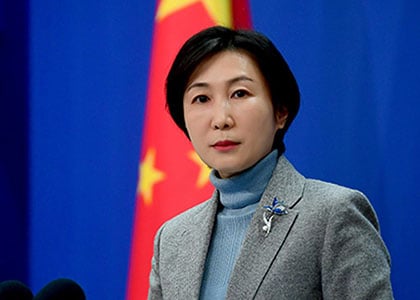
Amidst the swirling currents of geopolitical tension, China has issued a clear and unequivocal statement regarding the escalating crisis surrounding Iran. In what can only be described as a strategic diplomatic intervention, Chinese Ministry of Foreign Affairs (MFA) spokesperson Mao Ning expressed Beijing’s earnest hope that the Iranian government and people would overcome their current difficulties and maintain national stability. This sentiment, however, carries far more weight than simple well-wishing, arriving on the heels of US President Donald Trump's menacing threats of “very serious options,” including possible military action against Iran.
Key Takeaways:
-
Firm Rejection of Force: China explicitly opposes the use or threat of military force in international relations, directly challenging the aggressive rhetoric from Washington.
-
Upholding Sovereignty: Beijing underscores the importance of fully protecting the sovereignty and security of all nations under international law, a principle often invoked to counter perceived Western interventionism.
-
Call for Stability: The emphasis on Iran's internal stability reflects China's economic interests in the region, particularly its energy imports and 'Belt and Road' initiatives.
-
Implicit Critique of US Policy: Mao Ning's comments, made at the request of media regarding Trump's statements, serve as a thinly veiled rebuke of US foreign policy and its potential to destabilize the Middle East.
-
Regional Peace Mandate: China urges all parties to contribute more to peace and stability in the Middle East, positioning itself as a responsible global actor.
China's Strategic Calculus: A Global Counter-Narrative
Beijing’s statement is not merely a reiteration of diplomatic platitudes; it is a meticulously calibrated response designed to achieve multiple strategic objectives. Firstly, it reaffirms China's consistent foreign policy stance against interference in the internal affairs of other countries. This principle, a cornerstone of Chinese diplomacy, is wielded not just for ideological consistency but also to protect its own sovereignty and deter similar external pressures.
Secondly, by speaking out against the use of force, China implicitly critiques the United States’ historical and current approach to international disputes. In a world increasingly wary of unilateral military adventures, Beijing is subtly positioning itself as a champion of multilateralism and international law. This narrative resonates well with many developing nations and those fatigued by interventionism, enhancing China's soft power and diplomatic influence.
The Shadow of US Unilateralism and Iran's Predicament
Trump's threats, amplified by growing reports of unrest within Iran, plunge an already volatile region into deeper uncertainty. The prospect of military action, regardless of its ultimate feasibility or intention, sends ripples of anxiety across global markets and diplomatic circles. For Iran, grappling with internal dissent and external sanctions, China's declaration of support, however qualified, offers a much-needed diplomatic shield. It signals to Tehran that it is not entirely isolated on the world stage, and that powerful nations still advocate for its territorial integrity.
However, Beijing's concern for stability in Iran is not purely altruistic. Iran is a crucial energy supplier for China and a significant node in its ambitious Belt and Road Initiative. Any widespread instability or conflict in the region threatens these vital economic interests, underscoring the pragmatic dimensions of China’s diplomatic stance.
Geopolitical Chessboard: Redrawing the Rules of Engagement
This episode further highlights the intensifying geopolitical rivalry between the US and China. As Washington continues to pivot its strategic focus towards countering Beijing, China’s firm stance on Iran serves as a reminder that the global power structure is shifting. Beijing is actively challenging the traditional dominance of Western powers in defining international norms and interventions. Its call for restraint and adherence to international law can be interpreted as an effort to establish a new framework for global engagement, one less susceptible to the whims of any single superpower.
Public Sentiment
Online forums and international think tanks are alight with varied reactions. Many observers commend China's stance, viewing it as a necessary voice for de-escalation in a tense climate. "Finally, a major power speaking common sense and upholding international law," one commentator posted. Others, however, remain skeptical, suggesting China's motives are primarily self-serving. "Beijing is simply protecting its oil pipelines, not genuinely advocating for peace," another remarked, highlighting the complex lens through which such pronouncements are often viewed. A common thread across discussions is the shared anxiety over the potential for miscalculation and the devastating consequences of military conflict in the Middle East.
Conclusion
China's intervention in the Iran discourse is more than just a diplomatic statement; it is a strategic assertion of its evolving role on the global stage. By advocating for stability, sovereignty, and the rejection of force, Beijing is not only attempting to cool tensions in a critical region but also subtly redefining the parameters of international conduct. The global community watches to see if China’s calculated calm can genuinely temper the hawkish rhetoric, or if it merely adds another layer of complexity to an already combustible geopolitical landscape. The path to peace in the Middle East, it seems, will now inevitably involve a more prominent and opinionated Chinese voice.